
A high handicap can make every lost ball feel like a small tax on the round. A ball that launches easily, feels comfortable off the clubface, and stands out in rough can make the next shot less frustrating. That is why golfers often search for the best golf balls for high handicappers instead of automatically buying the most expensive tour model. The right ball cannot repair a swing flaw, but its construction, cover, feel, visibility, and alignment features can suit the way many developing players actually play.
The common mistake is choosing by brand name alone or assuming the longest ball on the shelf will produce the best result. High handicappers have different priorities. A golfer with a slower swing may prefer a low-compression design, while another player may care more about reduced side spin, easy tracking, or a softer feel around the green. Cover material matters too. Two-piece distance balls can be practical for golfers who lose several balls per round, while a urethane-covered ball may appeal to a player who is beginning to focus on approach shots and short-game control.
This guide compares nine distinct options from the selection, including soft-feeling models, distance-focused balls, high-visibility choices, and a premium tour ball. The emphasis is on documented construction and intended use rather than unverified distance claims. Package size, color, and model generation are also separated where they create a practical buying difference, so you can choose a ball that fits your game instead of chasing marketing noise.
Quick Answer
- Soft-Feel Starting Point: Callaway Golf Supersoft Golf Balls (2025, White).
- Another Soft-Feel Model: Bridgestone e6.
- Premium Control Comparison: Titleist Pro V1 Golf Balls.
Comparison Table
| Product | Best Fit | Useful Feature | Main Trade-Off |
|---|---|---|---|
| Callaway Golf Supersoft Golf Balls (2025, White) | Best Overall | HyperElastic SoftFast Core is built around speed and soft feel. | White can be harder to track than yellow in leaves, rough, or overcast conditions. |
| Bridgestone Golf e12 Straight White | Best for Straighter Flight Design | Contact Force Dimple design is intended to reduce side spin. | It cannot correct an underlying slice or hook caused by the swing. |
| TaylorMade Golf 2021 Distance+ Golf Balls, White | Best for Distance-Focused Play | REACT Speed Core is designed for high-velocity performance. | Its distance-oriented construction offers less short-game specialization than a urethane ball. |
| TaylorMade Golf SpeedSoft Ink Golf Balls | Best for Visibility and Soft Feel | Ink pattern stands out more readily than a conventional solid-color finish. | The bold ink design may distract golfers who prefer an uncluttered ball. |
| Titleist Pro V1 Golf Balls | Best Premium Option for Short-Game Development | Soft cast urethane elastomer cover supports greenside spin and feel. | Premium construction may be difficult to justify for golfers who frequently lose balls. |
| Srixon Soft Feel Golf Balls, Soft Feel 14, Yellow | Best for Slower or Medium Swing Speeds | Low-compression design is suited to slower and medium swing speeds. | Golfers with faster swings may prefer a ball built around a different flight profile. |
| Bridgestone e6 | Best for a Soft Distance-Oriented Alternative | A separate ball model, rather than a color or pack variation. | Distance positioning does not establish a personal yardage gain. |
| Amazon Basics Core Soft Golf Balls, 12-Pack, Yellow | Best for Beginners and Alignment Help | Low-compression design is approachable for developing golfers. | Plastic and rubber construction is less specialized than a premium urethane design. |
| TaylorMade Noodle Long & Soft | Best for Straightforward Recreational Play | Distinct model with a straightforward recreational identity. | The product name does not establish a measured distance advantage. |
1. Callaway Golf Supersoft Golf Balls (2025, White): Best Overall

Callaway’s 2025 Supersoft is the most balanced choice in this group for a golfer who wants a forgiving-feeling ball without narrowing the decision to one part of the game. Its HyperElastic SoftFast Core is intended to support faster ball speed with a soft sensation, while the hybrid cover is aimed at combining distance, durability, and touch near the green. That combination fits the typical high-handicapper’s scorecard, where a tee shot may need help getting airborne in the morning and a chip may need a little more feel later in the round.
The white finish keeps the ball familiar and easy to follow against a blue sky, though golfers who regularly play into leaves or tall grass may prefer a yellow version. The documented design does not mean every golfer will hit farther or straighter, but it gives this ball a sensible middle ground. A player who dislikes the hard click of some distance balls may appreciate the softer impact sensation, while someone who is beginning to work on pitches and bump-and-runs gets more short-game emphasis than a basic distance ball typically promises.
Pros
- HyperElastic SoftFast Core is built around speed and soft feel.
- Hybrid cover supports a balance of distance, durability, and greenside feel.
- Cover system is intended to provide more control on approach and short-game shots.
- White color offers a familiar look at address and in flight.
- Versatile design suits golfers who want one ball for the full bag.
Cons
- White can be harder to track than yellow in leaves, rough, or overcast conditions.
- Golfers seeking a strongly specialty-focused ball may prefer a dedicated straight-flight or premium urethane model.
This is the strongest starting point for a high handicapper who has no single dominant preference. It offers a soft, approachable feel while leaving room to develop a more deliberate short game. A golfer who loses balls frequently may choose a less expensive distance option, and a player who needs maximum visibility may select the yellow version, but the 2025 white Supersoft is the easiest recommendation for mixed everyday play.
To buy this product, click here.
2. Bridgestone Golf e12 Straight White: Best for Straighter Flight Design

The Bridgestone e12 Straight takes aim at one of the most familiar high-handicapper frustrations: a tee shot that starts reasonably and then bends farther than expected. Its listed Contact Force Dimple design and Optimal Flight System are positioned around reduced side spin, improved forgiveness, and a straighter flight profile. Those are design goals, not guarantees that the ball will erase a slice, but they make the e12 a logical option for golfers who want a ball selected with directional consistency in mind.
This model also offers a choice of white, matte green, and matte yellow in the product description. The white version keeps the appearance classic and clean. A golfer who plays a wide-open course may value the e12’s flight emphasis, while someone who spends the afternoon searching beside fairways should pay closer attention to available color choices. It is a practical fit for the player who wants to focus on making a confident swing rather than wondering whether the ball will exaggerate every small face-angle error.
Pros
- Contact Force Dimple design is intended to reduce side spin.
- Optimal Flight System supports a straighter-flight positioning.
- Forgiveness-focused design suits golfers managing inconsistent contact.
- White finish gives the ball a traditional appearance.
- Additional color options may help golfers match visibility needs.
Cons
- It cannot correct an underlying slice or hook caused by the swing.
- Golfers who prioritize pronounced greenside spin may prefer a urethane-covered premium ball.
The e12 Straight deserves a place near the top for the high handicapper who thinks about direction before raw distance. It may be especially appealing for someone whose miss sends several balls toward the same side of the course. Players who are already comfortable shaping shots or who want a very soft short-game response may find its design emphasis less relevant, but its stated purpose is unusually well matched to a common high-handicap concern.
To buy this product, click here.
3. TaylorMade Golf 2021 Distance+ Golf Balls, White: Best for Distance-Focused Play

The TaylorMade Distance+ is a straightforward choice for golfers who want a distance-oriented ball with a few useful extras. It uses a two-layer construction, REACT Speed Core, ionomer cover, and Extended Flight dimple pattern. The listed mid-launch profile and softer feel give it broader appeal than a completely hard-feeling range-style ball, while its design remains focused on keeping drives and long iron shots moving efficiently through the air.
The Plus Alignment Aid adds a small piece of help on the putting green. For a golfer who routinely stands over a short putt with the face slightly open or closed, a visible alignment mark can provide a repeatable starting routine. The white finish is easy to recognize, and the ball makes sense for casual rounds where a player wants dependable distance characteristics without placing too much emphasis on advanced greenside technique.
Pros
- REACT Speed Core is designed for high-velocity performance.
- Extended Flight dimple pattern is intended to support longer flight.
- Two-layer construction keeps the design simple and distance focused.
- Plus Alignment Aid can help establish a consistent putting setup.
- Ionomer cover offers a practical choice for everyday recreational rounds.
Cons
- Its distance-oriented construction offers less short-game specialization than a urethane ball.
- The 2021 model may be less appealing to golfers who specifically want the newest generation.
This is a good match for the high handicapper who is still building confidence from the tee and does not want to spend the round worrying about premium-ball wear. It also suits golfers who like an alignment aid but do not want a heavily marked ball. A player whose scoring improvement now depends on delicate wedge shots may eventually prefer a softer urethane option, but the Distance+ remains a sensible everyday ball for long-game priorities.
To buy this product, click here.
4. TaylorMade Golf SpeedSoft Ink Golf Balls: Best for Visibility and Soft Feel

Some golf balls disappear into the course with remarkable efficiency. The TaylorMade SpeedSoft Ink takes a different approach with a distinctive paint-splatter pattern that gives the ball a visual identity before it ever leaves the tee. That can be useful for high handicappers who spend too much time scanning the fairway, rough, or cart path for a plain white ball. The markings are also easy to recognize when several players are using similar equipment.
Under the appearance, this model uses a low-compression PWRCORE intended to deliver a soft feel with fast ball speed. The construction is aimed at comfortable performance across the bag, including iron shots and shots around the green. The listed Extended Flight dimple pattern and mid/high wedge-spin positioning give it more range than a basic novelty ball. A golfer who likes a gentle impact sensation but wants a ball that looks different from the crowd will find a clear reason to choose this one.
Pros
- Ink pattern stands out more readily than a conventional solid-color finish.
- Low-compression PWRCORE is built for a soft impact sensation.
- SpeedSoft construction is intended to support ball speed throughout the bag.
- Extended Flight dimple pattern supports a distance-oriented design.
- Mid/high wedge-spin positioning gives the ball short-game relevance.
Cons
- The bold ink design may distract golfers who prefer an uncluttered ball.
- Its distinctive appearance does not replace the need for proper alignment or contact.
Choose SpeedSoft Ink if your lost-ball problem is partly a visibility problem and you enjoy a softer feel. It is a lively alternative for casual weekend golf, especially for players who want their ball to be easy to identify in a busy foursome. Golfers who prefer traditional white or yellow finishes, or who want a dedicated low-side-spin design, may find another option more natural.
To buy this product, click here.
5. Titleist Pro V1 Golf Balls: Best Premium Option for Short-Game Development

The Pro V1 is a different kind of recommendation for a high handicapper. It is not selected because every developing golfer needs a premium tour ball. It earns a place because some high handicappers are already paying attention to wedge shots, trajectory, and putting feel, even while their score remains high. The Pro V1 uses a high-gradient core, a high-flex casing layer, a 388 tetrahedral dimple design, and a soft cast urethane elastomer cover. Those features support a more performance-oriented profile from tee to green.
Compared with the Pro V1x, the product description describes the Pro V1 as having a softer feel, less spin, and a flatter trajectory. That may suit a player who wants a penetrating flight and more control over iron and wedge shots. The urethane cover is also the clearest short-game distinction in this roundup, although a premium cover can make losing balls more painful and may be unnecessary for someone still hitting several penalty shots per round.
Pros
- Soft cast urethane elastomer cover supports greenside spin and feel.
- High-gradient core is designed to provide speed with iron and wedge control.
- High-flex casing layer is intended to reduce long-game spin.
- 388 tetrahedral dimple design supports a consistent, penetrating flight profile.
- Flatter trajectory and softer feel distinguish it from the Pro V1x.
Cons
- Premium construction may be difficult to justify for golfers who frequently lose balls.
- Its more advanced short-game profile can be more than a beginner needs.
The Pro V1 makes sense for a high handicapper who practices regularly, values delicate shots, and wants to use one premium ball while improving technique. It is less practical for a golfer whose main goal is simply to keep more balls in play. If your approach to the game has moved from “find the ball” to “learn what the ball does,” this is the selection with the most room for that next stage.
To buy this product, click here.
6. Srixon Soft Feel Golf Balls, Soft Feel 14, Yellow: Best for Slower or Medium Swing Speeds

The Srixon Soft Feel 14 is aimed at golfers who want a softer ball without giving up a practical all-around profile. Its low-compression construction is documented as a fit for slower or medium swing speeds, and the high-energy core is intended to support ball speed and easier launch. That focus matters for a golfer who watches a well-struck seven-iron climb quickly but sees mishits come out low and tired, especially late in a round.
The yellow cover adds a useful visibility advantage, while the 338 Speed Dimple Pattern is designed to reduce drag during launch and increase lift on descent. Srixon also describes the thin soft cover as supporting less driver spin and more greenside spin. Those are manufacturer design claims rather than guaranteed results, but the overall package is coherent. It gives a high handicapper an easy-launching, visible ball with more short-game attention than a basic two-layer distance model.
Pros
- Low-compression design is suited to slower and medium swing speeds.
- High-energy core is intended to support ball speed and easier launch.
- Yellow finish improves visibility in many playing conditions.
- 338 Speed Dimple Pattern is designed to manage drag and lift.
- Thin soft cover is positioned for a softer feel and greenside response.
Cons
- Golfers with faster swings may prefer a ball built around a different flight profile.
- Soft cover construction may not suit players who prioritize maximum resistance to visible wear.
This ball is a strong candidate for the golfer who swings smoothly rather than violently and wants a little help getting the ball into the air. The yellow finish is especially useful for players who lose sight of white balls against pale grass or cloudy skies. It may be less compelling for a golfer who wants a firm, high-speed sensation, but its low-compression positioning is closely aligned with many developing players.
To buy this product, click here.
7. Bridgestone e6: Best for a Soft Distance-Oriented Alternative

A thump that feels comfortable off the driver can make a ball easier to live with over a full round. Bridgestone positions the e6 around soft feel and distance, which gives it a clearer role here than a second color of the same ball. For a golfer who dislikes a hard click at impact, that brief gives the comparison a clear starting point. Think of a smooth tee shot on a quiet morning: the aim is a predictable response you enjoy, without treating a soft sensation as proof that the shot traveled farther.
The useful comparison happens closer to the hole as well. Drop an e6 beside your current ball for a short pitch, then hit a few putts at the same target. Its distance-oriented identity makes it a sensible candidate for ordinary recreational rounds, but a golfer selecting a ball primarily for tour-style wedge control should compare a urethane model too. On a breezy finishing hole, strike quality and launch still decide where that drive finishes. The e6 label cannot choose those for you.
Pros
- A separate ball model, rather than a color or pack variation.
- Manufacturer positioning emphasizes soft feel.
- Distance-oriented design suits a straightforward recreational shortlist.
- Offers another feel comparison alongside Supersoft or Soft Feel.
- Conventional golf-ball format works across a full round.
Cons
- Distance positioning does not establish a personal yardage gain.
- A golfer prioritizing tour-style greenside control should compare urethane options.
Choose the e6 because the soft, distance-oriented brief matches the way you play. A golfer walking nine holes after work can compare it without changing clubs or inventing a new swing. Keep the same model in play long enough to judge its chips and putts, since a pleasant driver sensation is only one part of the decision. For a high handicap, predictable feel and replacement cost are useful priorities while strike quality improves.
To buy this product, click here.
8. Amazon Basics Core Soft Golf Balls, 12-Pack, Yellow: Best for Beginners and Alignment Help

The Amazon Basics Core Soft ball focuses on the features that matter during the early learning curve: soft feel, visibility, a low-compression design, and a side-stamp alignment aid. A new golfer standing over a short putt may not need complicated technology, but a clear line on the ball can help create the same setup routine from one putt to the next. The yellow cover also makes the ball easier to identify for players who are still learning how far ordinary shots travel and where misses tend to finish.
The listed construction uses a plastic and rubber composition, with an advanced core and cover positioned for distance, straight flight, short-game control, and putting accuracy. Those are intended performance characteristics, not promises of lower scores. The 12-pack is a practical middle ground for a new golfer who needs spare balls for practice and play but does not want the larger supply of the 24-pack.
Pros
- Low-compression design is approachable for developing golfers.
- Yellow cover improves tracking across many course conditions.
- Side-stamp alignment aid supports a repeatable putting routine.
- Core and cover are positioned for distance and soft impact feel.
- 12-ball format provides a manageable supply for beginners.
Cons
- Plastic and rubber construction is less specialized than a premium urethane design.
- Golfers who lose balls regularly may prefer the larger package option.
This is a sensible entry point for the golfer who is still learning course management, ball tracking, and basic putting alignment. It also works for practice rounds where the ball may visit a few unplanned destinations. Players who are beginning to demand more specific wedge performance or a refined flight profile may eventually move up, but the combination of yellow visibility and alignment help gives this package a clear beginner-focused purpose.
To buy this product, click here.
9. TaylorMade Noodle Long & Soft: Best for Straightforward Recreational Play
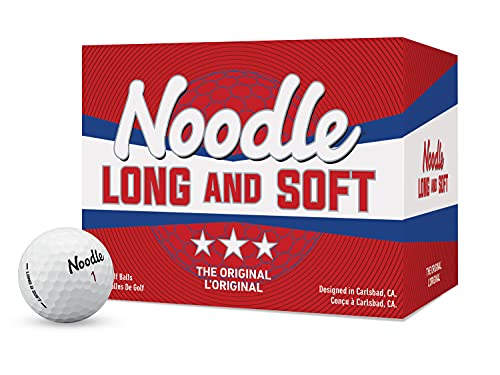
The Noodle Long & Soft gives this shortlist a different ball model with a simple brief: distance-oriented recreational play and a soft-feel identity. Its straightforward identity can appeal to someone who wants a consistent ball for ordinary rounds. Imagine a relaxed nine-hole round where the spare sleeve is likely to get used before the final tee. You can put this model beside your regular ball and compare the whole round, rather than expecting an expensive badge to make a rough swing behave.
The practical appeal is the uncomplicated choice, but the words Long & Soft are a product name rather than a personal distance guarantee. A smooth player and a fast, abrupt swinger can get different results from the same ball. Try a few chips before deciding whether the response around the green suits you, then compare tee shots under similar conditions. If you need a specific premium-cover spin profile or specialized flight window, those priorities deserve a closer look at other models instead of being inferred from the name.
Pros
- Distinct model with a straightforward recreational identity.
- Soft-feel positioning provides a useful comparison point.
- Distance-oriented brief suits casual full-round play.
- An alternative to adding another premium tour-style model.
- Simple model name is easy to keep consistent across purchases.
Cons
- The product name does not establish a measured distance advantage.
- Golfers prioritizing specialized greenside control may prefer a premium-cover alternative.
Put the Noodle on your shortlist for everyday golf rather than a promised transformation. A golfer practicing twice a week may care as much about keeping the same ball feel as chasing a few theoretical yards. Compare the actual pack price per ball, then let chips, putts, and solid strikes decide whether the trade-off works. For a high handicap, predictable feel and replacement cost are useful priorities while strike quality improves.
To buy this product, click here.
Buying Guide
Match the Ball to Your Swing Speed
High handicap describes scoring, not swing speed. Some high handicappers create plenty of clubhead speed but struggle with direction, while others swing gently and need a ball that launches comfortably. Low-compression options such as the Srixon Soft Feel, TaylorMade SpeedSoft, and Amazon Basics Core Soft are positioned for a softer feel and easier launch. That does not mean low compression is automatically longer for every player, so treat it as a fit characteristic rather than a distance guarantee.
Choose Between Distance and Short-Game Control
Two-layer and ionomer-covered balls generally make sense for golfers who prioritize everyday distance, durability, and a lower replacement cost. The TaylorMade Distance+ fits that role. A urethane-covered ball such as the Titleist Pro V1 places more emphasis on greenside spin and touch. If most of your strokes are lost around the green, premium cover technology may deserve attention. If lost balls and inconsistent tee shots dominate the round, a distance-focused design is usually the more practical starting point.
Think About Visibility Before Choosing a Color
White is familiar and easy to follow in many conditions, but yellow can stand out better against certain backgrounds. Visibility also depends on cloud cover, leaves, rough, and how quickly a golfer can pick up the ball after impact. The Srixon, Amazon Basics, and Callaway yellow options provide alternatives to conventional white. The TaylorMade SpeedSoft Ink uses a high-contrast pattern rather than a plain color, which may appeal to golfers who want quick recognition in a crowded group.
Use Alignment Features as Part of a Routine
A side stamp or alignment mark cannot square the putter by itself, but it can give you a repeatable visual reference. The TaylorMade Distance+ and Amazon Basics balls include alignment-oriented markings. Set the line before addressing the ball, then use the same routine rather than constantly adjusting the mark. This can make practice more purposeful, especially for a golfer who tends to rush short putts.
Do Not Expect a Ball to Fix a Slice
Some models are marketed around reduced side spin or straighter-flight design, including the Bridgestone e12 Straight. That makes the ball relevant to golfers managing a common directional miss, but no golf ball replaces work on clubface control, swing path, alignment, or contact. A ball can be selected to match your preferred flight characteristics. It cannot guarantee that a slice disappears on the first tee.
Account for How Many Balls You Lose
A golfer who loses one ball every few rounds can reasonably explore a premium model. Someone who loses several during a busy afternoon should weigh consistency and supply more heavily. The Amazon Basics 12-pack gives a beginner a manageable way to try a yellow low-compression ball, while the 24-pack suits regular practice and frequent replacement. The right package is the one that lets you play without protecting a single ball like it is the last one on Earth.
Best Golf Balls for High Handicappers FAQ
What Type of Golf Ball Is Best for a High Handicapper?
There is no single construction that suits every high handicapper. A soft-feeling, distance-oriented ball with useful visibility is a strong starting point for many players. The Callaway Supersoft 2025 offers a broad balance of speed-oriented core design, soft feel, and greenside control. Golfers with slower swings may also look closely at low-compression models such as the Srixon Soft Feel.
Are Soft Golf Balls Better for High Handicappers?
Soft balls can feel more comfortable and may suit golfers who prefer a gentle impact sensation or have slower to medium swing speeds. Softness alone does not guarantee more distance or straighter shots. Compare the core, cover, intended flight, and short-game positioning rather than choosing solely by the word “soft.”
Can a Golf Ball Reduce a Slice?
Some golf balls are designed around reduced side spin or a straighter-flight profile. The Bridgestone e12 Straight is the clearest example in this group. Its design may appeal to a golfer who wants that type of flight emphasis, but it cannot correct the clubface and swing-path factors that create a slice.
Should High Handicappers Use a Titleist Pro V1?
A high handicapper can use a Pro V1, especially if short-game feel and wedge control matter more than replacement cost. Its urethane cover and premium construction may be useful for a golfer who practices regularly and is learning to flight or shape approach shots. A golfer who loses several balls per round may get more practical value from a durable distance-oriented ball.
Are Yellow Golf Balls Easier to See?
Yellow can be easier for some golfers to track, particularly against darker grass or in certain overcast conditions. Visibility changes with light, foliage, and background color. The Srixon Soft Feel and Amazon Basics yellow models provide high-visibility options, while the SpeedSoft Ink offers a distinctive patterned appearance.
Does Golf-ball Color Affect Performance?
Color itself does not determine the ball’s compression, cover material, core, or dimple design. Those construction details have a greater effect on the ball’s intended playing characteristics. Color mainly affects visibility and personal preference, although a ball that is easier for you to locate can be more useful during an actual round.
How Many Golf Balls Should a High Handicapper Buy?
Buy enough for your normal playing and practice habits. A 12-pack is a reasonable starting supply for a golfer trying a new model. A 24-pack makes more sense for regular practice, frequent rounds, or a player who loses balls often. It is smart to test a ball before purchasing a large quantity if you are unsure about its feel or visibility.
Final Verdict
Supersoft is the comfortable starting point in this group, with e6 and Soft Feel providing useful comparisons. A high handicap does not automatically rule out Pro V1, but its control-oriented appeal has to justify the cost of replacing lost balls. Spend according to the part of your game you actually practice.
If several balls disappear into water each round, a repeatable feel and a manageable cost per ball can matter more than premium construction. Distance+, Noodle, and the larger recreational packs deserve attention for that routine. Compare the actual quantity at checkout, then keep one model in play while your contact and course decisions improve.
