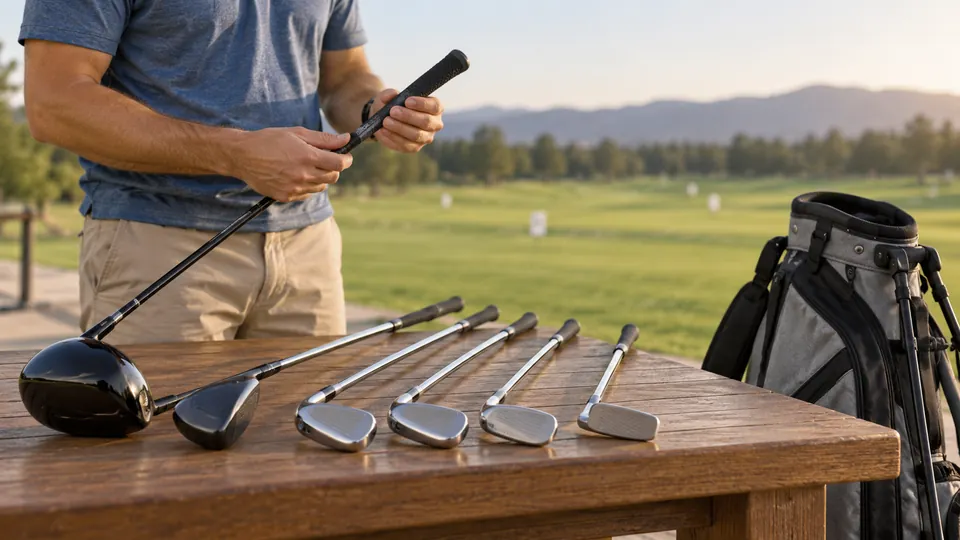
A beginner needs enough clubs to cover different jobs, not a bag filled with fourteen difficult choices. A useful first set gives you a manageable tee club, clubs for advancing the ball and approaching the green, a wedge, and a putter. Our golf club sets for beginners guide compares packages, but the first decision is what you will actually use while learning.
Imagine arriving at the range with a new set and no idea why three clubs seem to send the ball the same distance. Buying more clubs would not solve that confusion. Learning the purpose of a smaller, sensibly spaced selection gives each practice session a clearer direction.
Build Around Jobs Before Club Numbers
A tee club starts longer holes. An easy-launching longer club helps advance the ball when a mid-iron is not enough. A few irons cover progressively shorter approaches, a wedge handles many short shots, and a putter is used on the green. Those roles are more useful starting categories than a fixed shopping list.
You may eventually use more specialized options, but they do not all need to arrive with your first purchase. A long iron that rarely gets airborne or a very lofted wedge that you cannot yet control can make the bag look complete without making your decisions easier.
The Rules of Golf limit a player to fourteen clubs, but that is a maximum rather than a required beginner inventory. A smaller set can be perfectly workable. The right starting number depends on the clubs available, your lessons, the course you play, and how distinct their useful distances become.
A Simple First-Set Framework
| Role | Possible Starting Choice | What to Learn |
|---|---|---|
| Starting longer holes | Driver or another manageable tee club | Making a controlled start to the hole |
| Advancing the ball | Suitable hybrid or higher-lofted fairway wood | Useful flight from ordinary lies |
| Approaches | A small selection of irons | Different trajectories and distances |
| Short shots | Pitching wedge and a suitable sand wedge if needed | Contact, rollout, and basic bunker shots |
| Putting | A putter of suitable fit | Starting the ball on line and controlling pace |
This is a framework to discuss with a coach or fitter, not a demand to buy each item immediately. A borrowed or rental set may let you discover preferences before spending more. If an introductory lesson provides clubs, use that opportunity to learn which types feel manageable.
Half Set or Complete Package?
A half set keeps the choices simple and can reduce the amount you carry. You accept larger gaps between clubs and learn to work with the options available. That can be practical on a shorter course or during the early stages of learning, particularly when budget matters.
A complete package offers convenience: the clubs and bag arrive together, and the selection is intended to cover a broad range of situations. Check the actual inventory, though. Two packages advertised with a similar piece count can include different numbers of clubs because bags and headcovers may count as pieces.
Write down each included club before comparing prices. Notice whether the package includes the wedge you need for your course and whether its longest clubs are genuinely usable for you. A package with extra accessories is not automatically better value than one with fewer pieces and a more suitable club selection.
Which Specifications Deserve Attention First?
Start with handedness, comfortable playing length, manageable weight, and grips you can hold without strain. These basics can matter more than an impressive head finish or a long list of technology names. You should be able to take a normal address position without obviously reaching or crowding the ball.
Shaft flex is another fitting variable, but age and gender labels are shortcuts rather than complete measurements. A beginner can still benefit from trying sensible alternatives. Do not assume a fast-looking swing requires the stiffest option or that a senior label automatically suits every older player.
Grip size also deserves a check. A very large or very small grip can change how the club feels in your hands, while texture affects your preference in different weather. Discuss those observations with the person helping you choose the set rather than expecting one demographic label to settle every specification.
Tall Players Should Check More Than Height
Being tall can make standard-length equipment feel awkward, but height alone does not prescribe an exact extension. Arm length, posture, setup, and dynamic delivery all matter. A quick measurement can suggest a starting point, while hitting appropriate test clubs helps assess the actual result.
Our sets with tall-fit specifications guide is useful for comparing documented options. Check the stated lengths instead of accepting “tall” as a complete specification. Avoid buying a random extension simply because another golfer of similar height uses one.
For children, the issue is different again. Junior clubs should match the child’s development and dimensions; cutting down an adult set is not equivalent to choosing purpose-built junior equipment. A junior fitting or qualified coach can help identify a sensible starting arrangement without loading the child with unnecessary clubs.
Put the Budget Into Useful Equipment
Set a realistic amount for the clubs, bag, and any essential missing items before browsing. Leave room for practice or instruction if those are part of your plans. A slightly cheaper set that fits and gets used can be a more sensible starting point than a costly package that leaves no budget for learning.
If you are comparing entry-level packages, our club sets under $500 guide helps separate the advertised package from the included equipment. Check the current price and exact configuration before ordering, since listings can differ by handedness, length, shaft, or seller.
Used clubs can be worth considering, but inspect condition and completeness. Look at grips, shafts, heads, and any adjustable parts, and seek help if damage or authenticity is uncertain. A cheap purchase becomes less attractive when several grips need replacing or a missing wedge requires another immediate expense.
Learn Your Distances Before Filling Every Gap
Once you have a workable set, record ordinary distances from representative shots rather than your longest strike. At first, several clubs may overlap because contact is inconsistent. That does not necessarily mean the set is wrong or that you need to replace an iron immediately.
Look for recurring situations the current bag cannot handle. Perhaps you need a club between a comfortable iron and a fairway wood, or a wedge for the course’s bunkers. Add equipment to solve that identifiable problem rather than buying the next number because a full set is supposed to contain it.
A useful first set should make it easy to practice, play, and understand what happened. Choose a manageable collection, check the fit, and give each club a clear role. You can build a more detailed bag once your shots provide a reason for the next addition.
