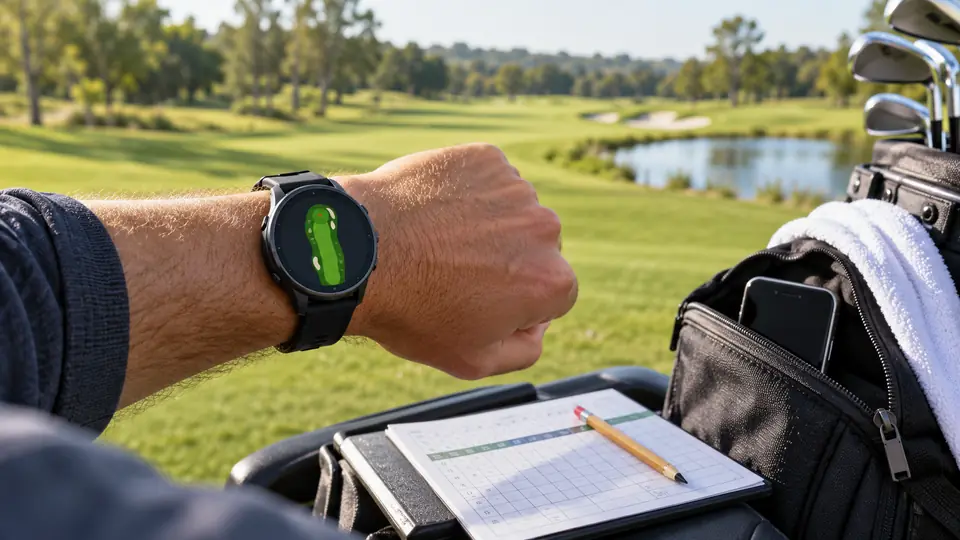
A golf GPS watch can turn a vague approach into a much calmer decision. Instead of pacing off yardage or pulling a phone from your pocket, you can glance at your wrist and see distances to the front, middle, and back of the green. The appeal is especially strong for golfers who want useful course information without another monthly bill attached to every round.
The tricky part is that “no subscription” does not mean every watch offers the same experience. Some models focus on simple yardages and physical buttons, while others add color maps, slope-related information, green contours, shot tracking, scorekeeping, and smartwatch features. A common mistake is choosing the watch with the longest course list without checking display visibility, battery needs, update requirements, or whether premium features still require a membership.
This guide compares nine GPS watch models for golfers who want subscription-free core course information. The selection includes straightforward distance watches, feature-rich models for course strategy, and connected smartwatches for players who also want health or notification tools away from the course. Your ideal choice may be a lightweight basic watch, a slope-capable touchscreen, or a more advanced model with optional accessories.
Quick Answer
- Start Here: NAVO W1 Golf GPS Watch. Front, middle, and back green distances are easy to reference.
- Compare Next: TecTecTec ULT-G Golf GPS Watch. Physical buttons are straightforward to use during a round.
- Another Approach: Garmin Approach S44. AMOLED display presents course information with a modern smartwatch appearance.
Comparison Table
| Product | Best Fit | Useful Feature | Main Trade-Off |
|---|---|---|---|
| NAVO W1 Golf GPS Watch | 1. NAVO W1 Golf GPS Watch , Best Overall | Front, middle, and back green distances are easy to reference. | The feature set is more focused than that of a full smartwatch. |
| TecTecTec ULT-G Golf GPS Watch | 2. TecTecTec ULT-G Golf GPS Watch , Best for Simple Operation | Physical buttons are straightforward to use during a round. | The display and controls are less modern than a full-color touchscreen. |
| Garmin Approach S44 | 3. Garmin Approach S44 , Best Connected Golf Watch | AMOLED display presents course information with a modern smartwatch appearance. | Several enhanced golf features require a Garmin Golf membership. |
| Voice Caddie T11 LT | 4. Voice Caddie T11 LT , Best for Green-Reading Tools | Green-undulation maps show break direction and elevation changes. | The feature-rich interface may feel excessive for golfers who want only basic yardages. |
| Izzo Golf Swami GPS Watch | 5. Izzo Golf Swami GPS Watch , Best for Club Suggestions | i-Caddie offers distance-based club suggestions. | The listed 10-hour golf GPS battery rating may be restrictive for extended play. |
| Voice Caddie T11 PRO | 6. Voice Caddie T11 PRO , Best for Advanced Shot Planning | OLED touchscreen provides a prominent display for course and green views. | The large feature set requires more learning than a basic distance watch. |
| Bushnell Golf iON Elite GPS Watch | 7. Bushnell Golf iON Elite GPS Watch , Best for Slope-Adjusted Yardages | Slope-adjusted yardages can be toggled off for tournament play. | The one-button design may limit navigation flexibility for golfers who prefer multiple controls. |
| Garmin Approach S50 | 8. Garmin Approach S50 , Best for Golf and Everyday Fitness | Combines golf yardages with broad everyday smartwatch functions. | Some advanced golf features require a Garmin Golf membership. |
| Garmin Approach S12 | Best for Straightforward Core Yardages | Core green yardages do not require a recurring golf membership. | Monochrome interface lacks the color-map presentation of newer AMOLED models. |
1. NAVO W1 Golf GPS Watch: Best Overall

The NAVO W1 gets the central assignment right: show useful golf distances quickly, keep the phone in the bag, and avoid a recurring subscription. Its display provides front, middle, and back green yardages along with key hazard information, giving a golfer enough context to choose a club without turning the round into a technology exercise. The listed database includes more than 42,000 courses worldwide, which gives this model broad reach for golfers who travel or regularly play different layouts.
Its lightweight construction and high-contrast display suit a sunny afternoon where a dim screen can become frustrating fast. Once the course is loaded, the watch operates independently, so a walking golfer can leave the phone in a cart, bag, or locker. It is a particularly sensible match for someone who wants a dedicated golf tool rather than a general smartwatch with a long list of unrelated functions.
Pros
- Front, middle, and back green distances are easy to reference.
- Hazard tracking adds useful information for approach and layup decisions.
- More than 42,000 preloaded courses support play in many locations.
- Works on the course without requiring a phone.
- High-contrast, sunlight-readable display supports outdoor use.
Cons
- The feature set is more focused than that of a full smartwatch.
- Golfers seeking detailed health tracking or advanced club analytics may need another model.
The NAVO W1 is the strongest match for golfers who want a clean, subscription-free yardage experience with useful hazard information. It should appeal to weekend players who dislike clutter and frequent phone checks, along with travelers who value a large course database. Golfers who want green contours, fitness tracking, or elaborate shot analytics will find its focused approach less expansive, but that restraint is part of the appeal here.
To buy this product, click here.
2. TecTecTec ULT-G Golf GPS Watch: Best for Simple Operation
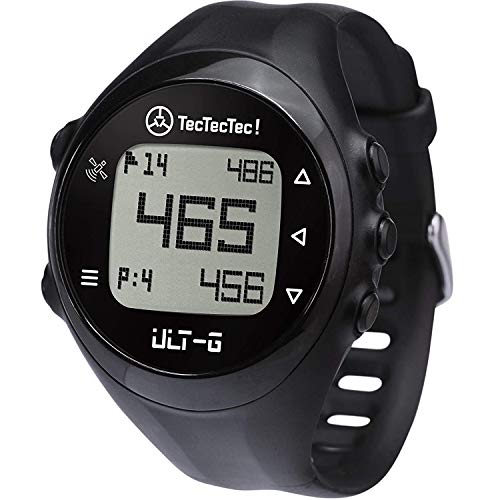
The ULT-G takes a refreshingly direct route. Instead of relying on a touchscreen, it uses five physical buttons and a clear display, so golfers can select a course, start a round, and move through holes without fiddling with small on-screen controls. That arrangement can be helpful on a brisk morning when gloves are on or after a shot when the goal is to get a number and keep moving.
It provides front, center, and back distances, hazard information, and shot-distance measurement. Automatic hole progression reduces manual input during a round, while the optional companion app handles free course and firmware updates. The watch weighs 55 grams and is described as water-resistant, with battery life rated for up to 2.5 rounds per charge. Those details make it a practical choice for golfers who favor dependable golf functions over a colorful smartwatch interface.
Pros
- Physical buttons are straightforward to use during a round.
- Front, center, and back yardages are paired with hazard information.
- Automatic hole progression reduces repeated setup.
- More than 38,000 courses are preloaded.
- Battery life is listed for up to 2.5 rounds per charge.
Cons
- The display and controls are less modern than a full-color touchscreen.
- Course and firmware updates require the optional companion app process.
The ULT-G suits golfers who want a watch that behaves more like a dedicated yardage instrument than a phone on the wrist. It is especially appealing for players who dislike subscription fees and complicated menus. A golfer who wants detailed maps, health features, or rich graphics should look elsewhere, but someone who values clear numbers, physical controls, and automatic hole changes will find the simpler design reassuring.
To buy this product, click here.
3. Garmin Approach S44: Best Connected Golf Watch

The Garmin Approach S44 brings a more smartwatch-like feel to the golf course through its 1.2-inch color AMOLED display. It supplies front, middle, and back green distances, plus hazard views for bunkers, water, and layups. The 43,000-plus course database is one of the broadest in this group, while the slim 43 mm format keeps the watch suitable for golfers who plan to wear it beyond the weekend round.
Scorekeeping and smart notifications add convenience for a golfer who wants fewer reasons to reach for a phone. Pairing with optional CT1 or CT10 sensors can expand the system into club and shot tracking, though those accessories are separate purchases. The core watch functions fit the no-subscription search well, but Garmin Golf membership unlocks enhanced CourseView maps, green contours, PlaysLike Distance, and touch targeting. That distinction matters for shoppers who want every advanced golf feature included from day one.
Pros
- AMOLED display presents course information with a modern smartwatch appearance.
- More than 43,000 preloaded courses provide broad coverage.
- Hazard view includes bunkers, water hazards, and layups.
- On-watch scorekeeping reduces paper or phone use.
- Smart notifications work with paired iPhone and Android phones.
Cons
- Several enhanced golf features require a Garmin Golf membership.
- Club tracking requires optional CT1 or CT10 sensors.
The S44 is a good fit for a golfer who wants subscription-free basic yardages while leaving room for a broader connected setup. It makes sense for a player who checks texts on the course, tracks scores digitally, or expects to add club sensors later. A golfer who wants the lowest-complexity experience may prefer the NAVO W1 or ULT-G, while a golfer seeking the full CourseView feature set should budget for Garmin’s optional membership.
To buy this product, click here.
4. Voice Caddie T11 LT: Best for Green-Reading Tools

The T11 LT is aimed at golfers who want more than a number beside the green. Its green-undulation technology uses heat maps and arrows to show break direction and elevation changes, while Putt View and Smart Green features bring pin placement and green information onto the color touchscreen. For a golfer standing over a long putt and trying to make sense of a subtle ridge, those visual cues offer more context than basic front and back yardages.
The watch also provides slope mode, course view, practice tempo mode, and automatic score tracking for left- and right-handed golfers. More than 40,000 courses are preinstalled, and the product description specifies no monthly subscription or additional course fees. It is a feature-rich choice, although golfers accustomed to simple button controls may need time to learn the touch interface and decide which views are useful during a fast-moving round.
Pros
- Green-undulation maps show break direction and elevation changes.
- Putt View and Smart Green provide more detail around the putting surface.
- Color touchscreen displays front, center, and back yardages.
- Slope mode adds elevation-related shot information.
- Automatic score tracking supports right- and left-handed golfers.
Cons
- The feature-rich interface may feel excessive for golfers who want only basic yardages.
- Touchscreen operation can be less convenient than physical buttons in some conditions.
The T11 LT is a strong choice for players who think carefully about approach angles and putting surfaces. It gives a round more visual detail without adding a recurring course fee, and its practice tempo mode broadens its usefulness away from normal play. Golfers who prefer quick glances and almost no setup may be happier with a simpler watch, while players who enjoy seeing the shape of a green will find this model more engaging.
To buy this product, click here.
5. Izzo Golf Swami GPS Watch: Best for Club Suggestions

The Izzo Golf Swami adds a practical decision aid to the familiar front, back, and center yardage format. Its i-Caddie technology provides personalized club suggestions based on distance from the target, which may help a golfer who often stands between clubs and wants a starting point for the shot. The watch also identifies layup and carry distances for hazards, doglegs, and bunkers, giving the number on the screen more strategic meaning.
Auto-course recognition and automatic hole advance keep the round moving, while a digital scorecard and shot-distance measurement give the watch useful recordkeeping duties. It includes more than 38,000 global course maps without course-map update fees. The rated golf GPS battery life is up to 10 hours, and a magnetic charger simplifies the charging routine, though golfers who regularly play very long days should compare that figure with their usual schedule.
Pros
- i-Caddie offers distance-based club suggestions.
- Layup and carry information covers common hazards and doglegs.
- Auto-course recognition reduces startup steps.
- Automatic hole advance and a digital scorecard support smooth play.
- Magnetic charging and water-resistant construction add daily convenience.
Cons
- The listed 10-hour golf GPS battery rating may be restrictive for extended play.
- Club suggestions are a guide and still depend on the golfer’s own distances and conditions.
The Swami works well for golfers who want help translating yardage into a club choice without carrying a separate notebook or opening an app. It is a particularly approachable option for players still building reliable distance routines. More advanced golfers may prefer slope, green contour, or wind-related tools, but the Swami keeps its emphasis on practical club selection and uncomplicated course navigation.
To buy this product, click here.
6. Voice Caddie T11 PRO: Best for Advanced Shot Planning

The T11 PRO is the most information-heavy Voice Caddie in this group. Its 1.3-inch OLED touchscreen is built to keep approach, putting, and course views readable across changing light, while V.AI 3.5 adds automatic slope calculation and strategic information from tee to green. The feature list includes a slope guide, club recommendations, wind direction, long-putt guidance, and swing-speed radar, giving advanced golfers plenty to explore.
More than 40,000 preloaded courses and MyVoiceCaddie app connectivity allow the watch to be customized around a player’s preferences. Its battery is rated for up to 12 hours, or 36 holes, and a portable charging station is included. This is a strong fit for golfers who enjoy detailed information and are willing to spend time learning the interface. A player who wants one large yardage and little else may find the extra layers distracting.
Pros
- OLED touchscreen provides a prominent display for course and green views.
- V.AI 3.5 supports automatic slope calculation and strategic information.
- Includes club recommendation, wind direction, and long-putt guidance tools.
- More than 40,000 courses are preloaded.
- Up to 12 hours of battery life and a portable charging station support long play.
Cons
- The large feature set requires more learning than a basic distance watch.
- Some advanced tools may be unnecessary for golfers who want minimal on-course information.
The T11 PRO is for the player who enjoys making a plan before every shot and wants the watch to supply several pieces of context. Its slope and recommendation tools can be useful for hilly layouts, while the green views speak to golfers who spend serious attention on the short game. It is less suitable for someone seeking the lightest mental and financial commitment, but it is a compelling premium choice for information-focused rounds.
To buy this product, click here.
7. Bushnell Golf iON Elite GPS Watch: Best for Slope-Adjusted Yardages

The iON Elite focuses on fast access to course information through a color touchscreen and a single-button interface. That arrangement keeps the interaction relatively direct, including for golfers wearing gloves, while the screen presents HoleView, GreenView, dynamic mapping, and hazard information. The watch also offers slope-adjusted yardages that can be toggled off for tournament-legal mode, giving golfers flexibility across casual and regulated play.
Its 38,000-plus course database covers a wide selection of layouts, and shot-distance tracking can be activated with a tap. Scorekeeping and automatic course navigation add useful round-management tools. The battery is listed for more than 12 hours, with USB-C magnetic charging, which is convenient for golfers who want a familiar charging connection and enough capacity for two full rounds according to the product description.
Pros
- Slope-adjusted yardages can be toggled off for tournament play.
- HoleView, GreenView, and dynamic mapping add visual course context.
- Single-button operation keeps controls straightforward.
- Shot-distance tracking and scorekeeping are built into the golf experience.
- USB-C magnetic charging and more than 12 hours of listed battery life suit extended play.
Cons
- The one-button design may limit navigation flexibility for golfers who prefer multiple controls.
- Its course database is smaller than the 43,000-plus listings on some Garmin models.
The iON Elite fits golfers who want slope information without carrying a rangefinder and who appreciate a visual map on the wrist. The ability to disable slope is a meaningful detail for players who occasionally compete under rules that restrict slope-adjusted information. Golfers who want a broad everyday smartwatch may prefer Garmin, while golfers focused on yardage, mapping, and quick controls should find the Bushnell approach appealing.
To buy this product, click here.
8. Garmin Approach S50: Best for Golf and Everyday Fitness

The Approach S50 makes sense for golfers who want their GPS watch to stay useful after the last putt drops. On the course, it provides front, middle, and back distances, hazard views, scorekeeping, and PlaysLike Distance for elevation-adjusted yardage. Away from golf, its feature set includes wrist-based heart rate, stress tracking, Body Battery, sleep monitoring, activity profiles, Garmin Pay, and music support through compatible services.
The 1.2-inch AMOLED display and 43,000-plus preloaded courses place it firmly in the connected smartwatch category. Battery life is listed at up to 15 hours in GPS mode and up to 10 days in smartwatch mode. Optional CT1 or CT10 sensors can add club tracking. As with the S44, enhanced golf functions such as detailed CourseView maps, green contours, and certain advanced tools are tied to Garmin Golf membership, so the subscription-free core and the complete feature set are separate considerations.
Pros
- Combines golf yardages with broad everyday smartwatch functions.
- PlaysLike Distance accounts for elevation changes in shot planning.
- More than 43,000 courses are preloaded.
- Health, sleep, activity, and stress features extend use beyond golf.
- GPS battery life is listed at up to 15 hours.
Cons
- Some advanced golf features require a Garmin Golf membership.
- Optional club sensors are needed for expanded automatic shot tracking.
The S50 is a good fit for a golfer who wants one watch for the course, the gym, and daily routines. A player who rarely uses fitness or notification tools may be paying for capabilities that stay untouched, while a golfer who wants an all-day device can make better use of the broader platform. Choose it for versatility, and choose a simpler GPS watch if subscription-free golf yardages are the only requirement.
To buy this product, click here.
9. Garmin Approach S12: Best for Straightforward Core Yardages
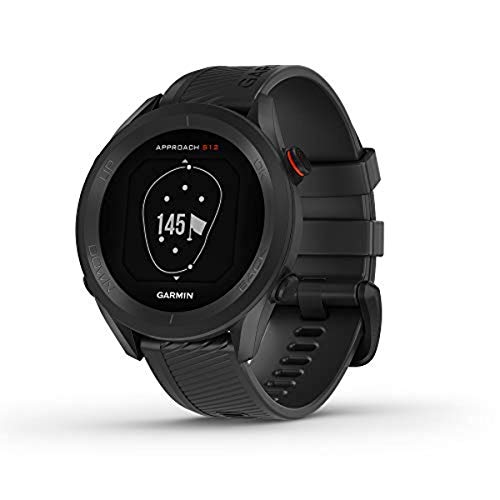
The Approach S12 is the Garmin option for a golfer who wants ordinary course information without treating a paid map upgrade as part of the routine. Front, middle, and back green distances, hazards, and scoring provide the core golf brief. Picture a quiet first tee: select the course, check the green distance, then put your attention back on the shot. The watch’s button-operated approach gives it a different identity from the AMOLED touchscreen models elsewhere in this comparison.
Its sunlight-readable monochrome display is also a deliberate trade-off. A player who mainly glances at a yardage may value that simplicity, while someone who enjoys a detailed color map may find it too restrained. On a second scenario, a dogleg with a hazard ahead makes the additional course distances more useful than a single center-green number. Check your regular course in Garmin’s coverage list and keep course updates current. Optional club-tracking accessories are a separate purchase, and the S12 should not be treated as a cheaper way to obtain every S44 or S50 premium feature.
Pros
- Core green yardages do not require a recurring golf membership.
- Hazard and course-target distances add context to the green number.
- Physical buttons provide an alternative to touch navigation.
- Sunlight-readable monochrome display favors a simple view.
- Scoring functions keep basic round information on the wrist.
Cons
- Monochrome interface lacks the color-map presentation of newer AMOLED models.
- Physical buttons offer a different navigation experience from a touchscreen.
Choose S12 if the core information is the job you want done. A golfer who checks a front edge before an approach and records a score afterward may have little use for premium-map subscriptions. A golfer who wants detailed contour views should compare a different model and its paid features instead of assuming every Garmin golf watch shares the same display tools.
To buy this product, click here.
Buying Guide
Confirm What “No Subscription” Covers
A subscription-free watch should provide its core course distances without a monthly payment, but advanced features can follow different rules. The NAVO W1, ULT-G, Izzo Swami, Voice Caddie models, and Bushnell iON Elite are presented with subscription-free course access in the product description. Garmin’s S44 and S50 provide core golf functions without a recurring fee, while enhanced maps, green contours, PlaysLike Distance, and touch targeting may require Garmin Golf membership. Read the feature list around the specific tools you care about rather than treating the phrase as a promise that every function is included.
Choose the Right Display and Controls
A physical-button watch such as the TecTecTec ULT-G can feel reassuring when a golfer wants one quick yardage and minimal menu work. Touchscreen models such as the Voice Caddie T11 LT, T11 PRO, Bushnell iON Elite, and Garmin watches offer richer maps and graphics, but they also put more information on a smaller screen. Think about your normal round. A golfer walking in bright sun may value contrast and simplicity, while a golfer who studies green shape may prefer color maps and touch controls.
Separate Basic Yardages From Strategic Tools
Front, middle, and back distances are the foundation of a GPS watch. Hazard information adds another layer by showing whether a fairway bunker, water hazard, layup, or dogleg changes the safest target. Green undulation, Putt View, slope, wind direction, club recommendations, and PlaysLike Distance go further, but they also make the interface more involved. Decide whether you want a yardage reference or a more complete on-course planning system.
Check Battery Needs Before Long Rounds
Battery figures vary across this group. The ULT-G lists up to 2.5 rounds per charge, the Swami lists up to 10 hours in golf GPS mode, the T11 PRO lists up to 12 hours, and the Garmin S44 and S50 list up to 15 hours in GPS mode. Bushnell lists more than 12 hours for the iON Elite. A golfer who usually rides nine holes has different needs from someone who walks 36 holes over a weekend, so compare the stated rating with your actual schedule.
Decide Whether You Need a Phone on the Course
Several watches operate independently after course selection, which keeps the phone in a bag or cart and reduces distractions. Garmin models can display smart notifications when paired with a phone, while the TecTecTec companion app is intended for free updates rather than required on-course operation. If leaving the phone behind is the goal, prioritize independent golf operation. If you want texts, calls, music, or health tracking, a connected smartwatch may be a better match.
Think About Tournament and Slope Rules
Slope-adjusted information can help with uphill and downhill shots, but competition rules may restrict its use. The Bushnell iON Elite allows slope-adjusted yardages to be toggled off for tournament-legal mode. Voice Caddie models include slope-related tools, and Garmin’s enhanced features can also provide elevation-adjusted information. Check the rules of the events you play and make sure the watch can disable restricted functions when necessary.
Best Golf GPS Watch without Subscription FAQ
Can a Golf GPS Watch Work without a Phone?
Yes. Several watches in this roundup are intended to operate independently during a round after the course is selected or loaded. The NAVO W1, TecTecTec ULT-G, Izzo Swami, Voice Caddie watches, and Bushnell iON Elite can provide core golf information without requiring the phone to remain in your hand. Garmin watches can also provide golf distances independently, although phone pairing is needed for notifications and some app-based functions.
Do Subscription-free Golf GPS Watches Still Receive Course Updates?
Update policies vary by product. The NAVO W1, TecTecTec ULT-G, Izzo Swami, and Voice Caddie listings describe course access without recurring fees, while the ULT-G specifies free course and firmware updates through its companion app. Check the current update process for the exact model before purchase, particularly if you play new or frequently renovated courses.
Is a Touchscreen Better Than Physical Buttons on a Golf GPS Watch?
Neither control type is universally better. Physical buttons are easy to operate without worrying about accidental touches, and they can be useful with gloves. Touchscreens make color maps, green views, pin placement, and detailed graphics easier to navigate. Choose buttons for direct yardage access, or choose a touchscreen if course visualization matters more to you.
Do These Watches Show Hazards?
Yes. Hazard information is available on all of the selected models in some form, although the presentation differs. Basic watches may show distances to key hazards, while Garmin, Bushnell, and Voice Caddie models add visual hazard views or course maps. Review the exact hazard types listed for the watch if bunkers, water, layups, or doglegs are central to your strategy.
Can a Golf GPS Watch Replace a Rangefinder?
A GPS watch can replace a rangefinder for golfers who mainly need front, middle, and back green distances plus hazard information. A rangefinder remains useful for golfers who want a direct measurement to a specific flag, tree, or other target. Watches with slope and pin-position tools narrow that gap, but they still provide information through a different method.
Are Garmin Golf Watches Subscription-free?
Garmin’s S44 and S50 provide core on-course distances, hazard views, scorekeeping, and course access without requiring a membership for every basic function. The product description states that Garmin Golf membership unlocks enhanced CourseView maps, green contour data, PlaysLike Distance, and touch targeting. Buyers should decide whether the core functions are sufficient or whether those enhanced features are part of the intended purchase.
Which Golf GPS Watch Is Best for Walking Golfers?
A walking golfer should prioritize low weight, readable outdoor display, independent operation, and enough battery for the entire round. The NAVO W1, TecTecTec ULT-G, Garmin S44, and Bushnell iON Elite each address those needs in different ways. The best fit depends on whether you value minimal controls, a color display, slope information, or smartwatch connectivity.
Final Verdict
NAVO W1 and TecTecTec ULT-G suit the simple-yardage side of this comparison, while Garmin S12 offers a button-operated Garmin alternative. Voice Caddie T11 Pro is the feature-rich option whose maker explicitly says a subscription is unnecessary. Choose the screen and controls you will use comfortably before treating the largest course count as the deciding feature.
S44 and S50 can provide core golf information without a recurring plan, but their optional premium mapping and green-contour features belong in a separate cost calculation. Check the free feature set for your exact model and region. A watch that gives you the number you actually need is a better no-fee purchase than a sophisticated screen whose main attraction requires an upgrade.
