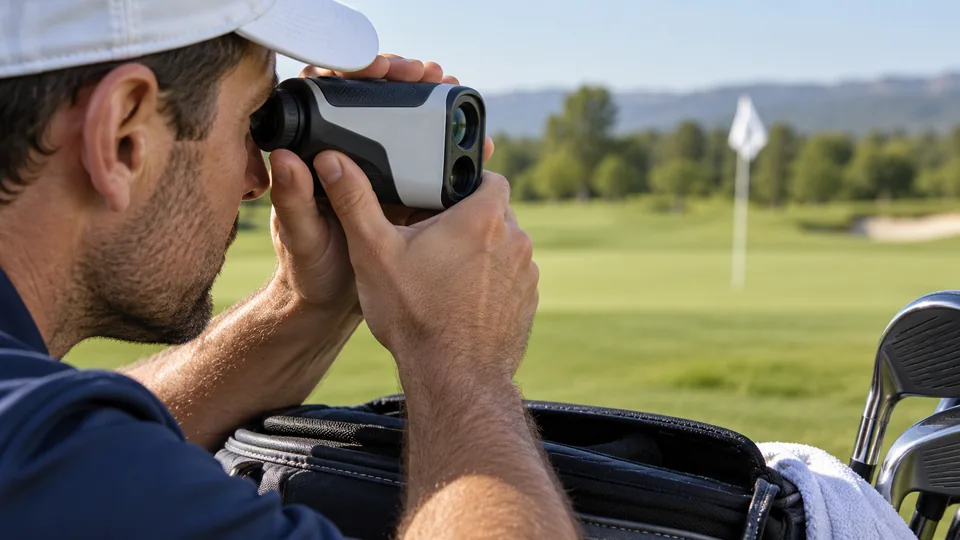
A flag dancing across the viewfinder can turn a simple yardage check into a fiddly pause before the next shot. For a golfer with shaky hands, actual image stabilization and a comfortable eyepiece are more direct buying features than a long advertised maximum range. A lock vibration can be useful too, but it answers a different question.
Image stabilization steadies the view; pin lock helps identify the flag against its background, and vibration confirms that acquisition. Slope compensation does another job again, adjusting the distance information for elevation. Picture a pin in front of trees, then a pin on a steep uphill approach. The same golfer can need these features for different reasons without any one of them replacing the others.
This comparison starts with Nikon’s documented STABILIZED system, followed by eight conventional laser alternatives with differing optics, controls, and target-confirmation features. Generic anti-shake advertising is treated as a claim rather than proof of equivalent optical stabilization. Choose the feature that addresses the part of the aiming routine you find difficult, then compare eyepiece comfort and handling.
Quick Answer
- Best for Documented Image Stabilization: Nikon COOLSHOT PROIII STABILIZED. Actual STABILIZED image stabilization addresses hand movement.
- Premium Target Confirmation: Bushnell Golf Tour V6 Shift. Visual Jolt and vibration provide dual confirmation of a locked target.
- Established Pin-Lock Alternative: Callaway Golf 300 Pro Slope Laser Rangefinder. Pin Acquisition Technology is specified to lock onto pins up to 300 yards.
Comparison Table
| Product | Best Fit | Useful Feature | Main Trade-Off |
|---|---|---|---|
| Nikon COOLSHOT PROIII STABILIZED | Best for Genuine Image Stabilization | Actual STABILIZED image stabilization addresses hand movement. | Replaceable CR2 power differs from a built-in USB charging routine. |
| Acer Pro Golf Rangefinder | 2. Acer Pro Golf Rangefinder , Best Overall | Pin-lock confirmation is useful after the target has been acquired. | Higher magnification can make aiming movement appear more pronounced before lock-on. |
| Bushnell Golf Tour V6 Shift | 3. Bushnell Golf Tour V6 Shift , Best Premium | Visual Jolt and vibration provide dual confirmation of a locked target. | The premium feature set may be more than a casual golfer needs. |
| Callaway Golf 300 Pro Slope Laser Rangefinder | 4. Callaway Golf 300 Pro Slope Laser Rangefinder , Best Established Brand | Pin Acquisition Technology is specified to lock onto pins up to 300 yards. | Its maximum range is lower than several 1,200-yard and 1,300-yard alternatives. |
| REDTIGER GolfVue Series 1 | 5. REDTIGER GolfVue Series 1 , Best for Range and Feature Flexibility | 7X magnification and a transflective display support distant target viewing. | The multiple modes may feel busy for golfers who only need straight-line distance. |
| SIGHTFLAG GF2 Golf Rangefinder | 6. SIGHTFLAG GF2 Golf Rangefinder , Best for High Magnification | 7.5X magnification provides a large view of distant flags and targets. | Higher magnification may amplify visible hand movement before the target locks. |
| Mossy Oak Golf Rangefinder | 7. Mossy Oak Golf Rangefinder , Best for Compact Rechargeable Use | 6X magnification offers a balanced view for golfers with hand movement. | The listing specifies ±1-yard accuracy rather than the tighter claims made by some alternatives. |
| MOESAPU Golf Range Finder | 8. MOESAPU Golf Range Finder , Best for Simple Operation | Physical slope control makes the active setting easy to check. | The listing describes a rainproof body but does not provide an IP rating. |
| Acer Golf Rangefinder 1200Y | 9. Acer Golf Rangefinder 1200Y , Best for Outdoor Versatility | The 6x view offers a moderate magnification choice. | The rangefinder does not list IP54 water resistance in the specifications. |
1. Nikon COOLSHOT PROIII STABILIZED: Best for Genuine Image Stabilization

A wobbling flag in the viewfinder is a different problem from wondering whether a laser has found the flag at all. Nikon’s COOLSHOT PROIII STABILIZED addresses the first problem with actual image stabilization, then handles target confirmation separately through DUAL LOCKED ON QUAKE. That distinction makes it the most direct starting point here for shaky hands. Picture aiming at a pin with trees behind it: keeping the view steadier helps you aim, while the confirmation signal tells you what the device believes it has acquired.
The 6x optic, diopter adjustment, and 18 mm eye relief add practical viewing details. Another golfer may be trying to read the flag after a long walk or while wearing glasses, so compare the eyepiece and controls in the way you normally use them. Nikon also provides slope-adjusted and actual-distance modes, but slope is a club-selection calculation rather than another form of stabilization. Select the permitted mode for the round. The CR2 battery is a replaceable-cell arrangement, which is useful to know if your usual charging routine revolves around USB-C devices.
Pros
- Actual STABILIZED image stabilization addresses hand movement.
- DUAL LOCKED ON QUAKE supplies a separate target-confirmation cue.
- 6x optics provide a defined viewing specification.
- Diopter adjustment and 18 mm eye relief support eyepiece fit.
- Actual-distance and slope-adjusted modes serve different uses.
Cons
- Replaceable CR2 power differs from a built-in USB charging routine.
- Image stabilization still requires the golfer to aim at the intended target.
Choose Nikon if steadying the view is the feature you are actually shopping for. Compare another laser on target confirmation if your hands are comfortable enough to aim but you struggle to distinguish the pin from background trees. Those are separate buying reasons. A golfer who cannot comfortably use an eyepiece may still prefer a GPS yardage device, since neither stabilization nor a vibration alert makes a laser the right tool for everyone.
To buy this product, click here.
2. Acer Pro Golf Rangefinder: Best Overall

The Acer Pro combines 7X magnification, pin-lock vibration, and a transflective LCD display. Its advertised anti-shake language should not be confused with Nikon’s documented image-stabilization system. Picture a flag moving around the crosshair as you try to settle the view: lock confirmation helps identify a reading, while stabilizing the viewed image addresses a different part of that experience.
It also covers the practical details that matter during a full round. The rangefinder measures from 5 to 1,200 yards, includes six modes, and uses a built-in 750mAh USB-C rechargeable battery. The external slope switch can disable slope information while preserving pin lock and vibration, which is useful for golfers who practice with slope but play events where slope must be off. IP54 water resistance, a magnetic stripe, case, strap, and lens cloth make it a sensible carry-around option rather than a device that stays buried in a golf bag.
Pros
- Pin-lock confirmation is useful after the target has been acquired.
- 7X magnification and a transflective display support clear target viewing.
- Pin lock provides vibration confirmation when the device identifies the flag.
- External slope switching supports practice and tournament-oriented use.
- USB-C charging, magnetic storage, and IP54 water resistance add course convenience.
Cons
- Higher magnification can make aiming movement appear more pronounced before lock-on.
- Six measurement modes may take practice for golfers who prefer one-button simplicity.
The Acer Pro is a feature-rich alternative for a golfer who wants its magnification and lock-confirmation tools. The 7X view enlarges the flag and can also make hand movement more noticeable. Compare how easily you can hold the target in view, then distinguish an advertising claim from a documented optical stabilization mechanism before choosing it for shaky hands.
To buy this product, click here.
3. Bushnell Golf Tour V6 Shift: Best Premium

The Tour V6 Shift is the premium choice for golfers who want a refined target-confirmation system rather than a long list of modes. Bushnell’s listed features include Pinseeker technology, Visual Jolt, and vibration. When the unit locks onto a flag, the red visual ring and tactile alert provide two separate cues. That matters for a golfer whose hands move while aiming because the device offers confirmation through the display and through touch.
The rangefinder also brings a 1,300-yard maximum range, 6X magnification, slope compensation, and an external slope switch. Its BITE magnetic mount allows quick attachment to a cart, so a player can retrieve it without digging through a bag after every approach. The Patriot Pack includes a case, battery, microfiber cloth, and quick-start guide. The product listing describes the unit as waterproof, though golfers should still follow the manufacturer’s care instructions rather than treating any rangefinder like a submerged device.
Pros
- Visual Jolt and vibration provide dual confirmation of a locked target.
- Pinseeker technology is built around identifying the flag.
- 6X magnification avoids the extra visual sensitivity of a higher-powered view.
- External slope control supports rounds where slope must be disabled.
- BITE magnetic mounting keeps the unit accessible on a golf cart.
Cons
- The premium feature set may be more than a casual golfer needs.
- The unit uses a CR2 battery rather than the USB-C rechargeable design found on several alternatives.
This Bushnell suits golfers who want a well-defined aiming routine: frame the flag, wait for the visual and tactile confirmation, then put the rangefinder away on the cart mount. It is especially appealing for players who find menus distracting or who prefer a focused golf-specific design. Golfers committed to rechargeable USB-C power may lean toward the Acer Pro or REDTIGER instead.
To buy this product, click here.
4. Callaway Golf 300 Pro Slope Laser Rangefinder: Best Established Brand

The Callaway Golf 300 Pro Slope takes a straightforward approach to steadier distance readings. Its Pin Acquisition Technology is specified to lock onto pins up to 300 yards away, while the pulse feature emits a short vibrating burst to confirm the reading. That tactile signal can be easier to trust than a tiny visual change when a golfer is trying to hold the unit steady on a windy tee box or an elevated green.
Its 6X magnification and documented 5-to-1,000-yard range cover ordinary golf-course needs without pushing the optical power higher than necessary. Slope measurement accounts for elevation changes, and the external slope switch allows the feature to be turned off for tournament play. The integrated Magnahold cart mount is another practical touch. A molded hard case with a carabiner and quick-close band helps protect the rangefinder between shots.
Pros
- Pin Acquisition Technology is specified to lock onto pins up to 300 yards.
- Pulse vibration gives tactile confirmation of the distance reading.
- 6X magnification offers a balanced view for flag aiming.
- External slope control supports competition-oriented use.
- Integrated magnetic cart mounting keeps the rangefinder within reach.
Cons
- Its maximum range is lower than several 1,200-yard and 1,300-yard alternatives.
- The product details describes a battery-powered unit rather than a USB-C rechargeable one.
The Callaway suits a golfer who wants a familiar golf interface and tactile pin-lock confirmation. That vibration confirms a target reading; it does not steady the viewed image. If movement in the viewfinder is the main obstacle, compare Nikon’s documented stabilization rather than assuming that every lock-vibration model addresses the same problem.
To buy this product, click here.
5. REDTIGER GolfVue Series 1: Best for Range and Feature Flexibility

The REDTIGER GolfVue Series 1 gives shaky-hand golfers a wide set of tools without losing the fundamentals of flag lock and vibration. Its specifications include 7X magnification, a 5-to-1,200-yard measurement range, a transflective LCD, and six measurement modes. Continuous scan, horizontal and height measurements, speed, slope compensation, and flag locking give it room to serve golfers who also use a rangefinder for outdoor activities.
The magnetic mount and included belt clip offer two carrying options. A player riding in a cart can attach the unit to metal, while a walker can keep it on a belt or golf bag. USB-C charging reduces the need to carry replacement batteries, and the product listing identifies IP54 water resistance. The 7X view can help with distant targets, but golfers with pronounced hand movement should brace their forearm or use the cart for support before pressing the measurement button.
Pros
- 7X magnification and a transflective display support distant target viewing.
- Flag lock and vibration provide clear target confirmation.
- Six measurement modes cover golf and broader outdoor use.
- USB-C charging is convenient between rounds.
- IP54 water resistance, a magnetic mount, and a belt clip support mobile use.
Cons
- The multiple modes may feel busy for golfers who only need straight-line distance.
- Higher magnification can make hand movement more visible during initial aiming.
This model suits a golfer who wants one rangefinder for golf, practice, and occasional outdoor measurement. It is particularly useful for someone who likes to scan or compare horizontal and height distances rather than using only pin lock. For verified image stabilization, compare the Nikon rather than treating a vibration alert as a steadier view.
To buy this product, click here.
6. SIGHTFLAG GF2 Golf Rangefinder: Best for High Magnification

The SIGHTFLAG GF2 is aimed at golfers who want a strong view of distant targets and a rich set of measurement modes. It lists 7.5X magnification, a 1,300-yard maximum range, a transflective LCD, and flag-lock vibration. The manufacturer accuracy claims vary by distance, but they should be treated as specifications rather than independent testing results. For shaky hands, the more useful feature is the combination of pin-seeking and vibration, which confirms that the device has recognized a target.
A 1,200mAh rechargeable battery, USB-C charging, a magnetic mount, a belt clip, and IP54 water resistance give the GF2 a practical outdoor setup. It also includes seven modes, including slope, flag lock, angle, speed, and continuous scan. The physical slope switch helps players see whether slope is active. That visible control is handy before a competitive round, when a golfer does not want to wonder which setting is currently engaged.
Pros
- 7.5X magnification provides a large view of distant flags and targets.
- Flag-lock vibration helps confirm target acquisition.
- Seven modes provide broad measurement flexibility.
- USB-C charging and a 1,200mAh battery support repeated use.
- IP54 water resistance and magnetic storage suit outdoor rounds.
Cons
- Higher magnification may amplify visible hand movement before the target locks.
- The extensive mode selection can require more setup than a basic golf rangefinder.
The GF2 makes sense for experienced golfers who are comfortable with optical devices and want the largest magnified view in this group. It can be a strong alternative to the Acer Pro for players who prioritize reach and mode variety. Those who find a moving image distracting may prefer 6X magnification and a simpler interface.
To buy this product, click here.
7. Mossy Oak Golf Rangefinder: Best for Compact Rechargeable Use

The Mossy Oak golf rangefinder keeps the core experience familiar: 6X magnification, flag lock, vibration, slope compensation, and two-button operation. That last detail matters for golfers whose hands are unsteady or whose attention is already split between club selection and the target. Fewer controls can mean less time searching for a mode while standing over a shot.
The specifications list a 1,200-yard maximum range, a high-definition LCD, USB-C charging, and a built-in 750mAh battery. The compact body can attach to a cart, bag, or belt, and the package includes a pouch, charging cable, cleaning cloth, and manual. It offers six modes, so it is more flexible than a single-purpose device, while the 6X view avoids the extra visual movement associated with higher magnification.
Pros
- 6X magnification offers a balanced view for golfers with hand movement.
- Two-button operation keeps the basic controls approachable.
- Flag lock and vibration confirm the selected target.
- USB-C charging and a 750mAh battery simplify routine use.
- Compact magnetic construction supports storage on a cart, bag, or belt.
Cons
- The listing specifies ±1-yard accuracy rather than the tighter claims made by some alternatives.
- The product description does not identify a dedicated anti-shake system.
This compact rechargeable model suits a golfer prioritizing a manageable size and a simple interface. Try bracing the arms and checking how comfortably the eyepiece meets the eye. Its lock features should be assessed separately from true image stabilization; Nikon is the relevant documented stabilization comparison in this guide.
To buy this product, click here.
8. MOESAPU Golf Range Finder: Best for Simple Operation

The MOESAPU F1000S stands out for small usability details that can make a rangefinder less awkward in the hands. Its physical slope switch uses different color markings for slope on and off, so the setting is visible without digging through a menu. Pin-lock vibration and continuous scan are available, while the high-transmittance LCD is intended to keep readings easy to see.
A built-in diopter adjustment gives users a way to sharpen the view for their own eyesight, including those who wear corrective lenses. The product data lists a 1,200-yard range, an 800mAh rechargeable battery, automatic shutoff after eight seconds, and a rainproof body. The stated flag-lock range is limited to the nearer target distances where golfers actually seek pins, while the larger maximum figure applies to general measurement.
Pros
- Physical slope control makes the active setting easy to check.
- Pin-lock vibration provides tactile target confirmation.
- Diopter adjustment helps users fine-tune the view.
- Continuous scan mode supports repeated measurements without restarting.
- Rechargeable power and automatic shutoff support routine course use.
Cons
- The listing describes a rainproof body but does not provide an IP rating.
- Lock confirmation does not stabilize a moving viewfinder image.
The MOESAPU is worth a look for golfers who become frustrated by tiny buttons and unclear slope settings. A visible switch and adjustable focus can make the setup feel more deliberate, especially for an older golfer or anyone whose eyesight changes across lighting conditions. For a documented image-stabilization system, compare the Nikon.
To buy this product, click here.
9. Acer Golf Rangefinder 1200Y: Best for Outdoor Versatility
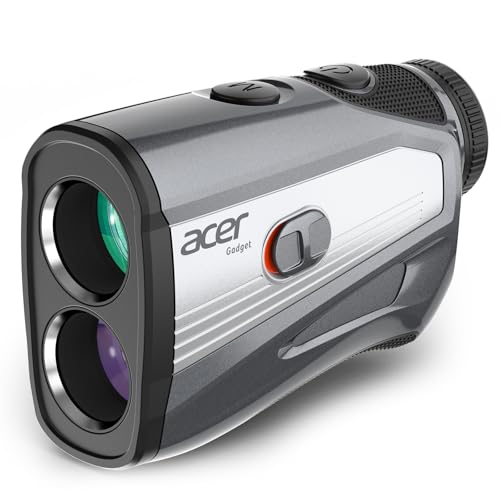
This Acer 1200Y model offers a 6X optical system, flag lock, vibration, and several measurement modes for different outdoor tasks. The advertising includes anti-shake wording, but that alone does not establish Nikon-style image stabilization. Picture a golfer sharing a device between the course and other outdoor measuring: the mode selection can matter, while a golfer chiefly struggling to hold a flag in view has a different priority.
The rangefinder measures from 3 to 1,200 yards according to the listing, switches between yards and meters, and uses a 750mAh USB-C rechargeable battery. The magnetic attachment is useful on a cart or metal club surface, while the included hand strap and case give a second way to carry it. The 6X magnification may be easier to manage than 7X or 7.5X for a golfer who sees too much movement through a highly magnified view.
Pros
- The 6x view offers a moderate magnification choice.
- 6X optics offer useful magnification without the highest zoom in this group.
- Flag lock and vibration help confirm the target.
- USB-C charging supports repeated rounds and outdoor sessions.
- Six modes and a magnetic mount broaden its practical use.
Cons
- The rangefinder does not list IP54 water resistance in the specifications.
- Its multiple outdoor modes may be unnecessary for golfers who want a dedicated pin finder.
Compare this Acer for its moderate 6X view and broader outdoor modes. A golfer who finds high magnification distracting may prefer that viewing scale, but the result needs a personal fit check. If the purchase specifically depends on a stabilized image, start with the Nikon rather than treating an advertised anti-shake phrase as equivalent engineering.
To buy this product, click here.
Buying Guide
Look for Target Confirmation, Not Maximum Yardage
A shaky view is less of a problem once the device clearly signals that it has found the flag. Vibration, pin lock, Pinseeker, Pin Acquisition Technology, and Visual Jolt all serve that basic purpose in different ways. A long maximum range is useful for general targets, but a golf rangefinder earns its keep by acquiring the flag at practical approach distances. A golfer standing beside a cart on a breezy afternoon benefits more from dependable confirmation than from a maximum figure that is rarely needed on the course.
Choose Magnification Carefully
Higher magnification can make a distant flag easier to see, but it can also make hand movement more obvious through the viewfinder. The SIGHTFLAG GF2 offers 7.5X, while the Acer Pro and REDTIGER provide 7X. Several other options use 6X. Golfers with mild movement may appreciate extra magnification, while users who struggle to keep the image centered may find 6X easier to manage. Bracing an elbow against the body or resting the rangefinder against a cart can also help.
Give Anti-Shake Claims the Right Weight
A documented image stabilizer is the direct feature for steadying a moving view. Nikon identifies that system separately from flag-lock confirmation. A lock vibration confirms target acquisition; it does not stop the image moving. Compare the eyepiece and controls too, since a usable view matters before a range number appears.
Check Slope Controls Before Tournament Use
Slope compensation adjusts the displayed distance for uphill or downhill shots, which can help during practice and recreational rounds. Tournament rules may require slope to be disabled. Models such as the Acer Pro, Bushnell Tour V6 Shift, Callaway Golf 300 Pro, and MOESAPU list a physical or external way to switch slope off. Always verify the rules for the specific event and confirm that the display no longer shows slope information before play.
Think About Charging and Carrying
USB-C charging is convenient if you already carry a phone cable or power bank, while a replaceable battery can be useful for golfers who do not want to remember to recharge. A magnetic mount is handy for riding golfers, but walkers may prefer a belt clip, strap, or case. A rangefinder that stays loose at the bottom of a bag is harder to retrieve quickly, especially when a golfer is trying to avoid rushing before a shot.
Match Water Protection to Your Routine
The REDTIGER, Acer Pro, and SIGHTFLAG listings identify IP54 water resistance. Other products describe a rainproof or waterproof body without the same rating in the product details. Water protection can add confidence during damp conditions, but it does not mean the rangefinder should be left exposed to heavy rain or stored wet. Wipe the lenses and body after a wet round, then allow the case and device to dry separately.
Best Golf Rangefinder for Shaky Hands FAQ
What Feature Matters Most for Shaky Hands?
Look for documented image stabilization if hand movement is the main difficulty. Pin lock and a vibration alert answer the separate question of target confirmation. The Nikon provides both kinds of assistance, while the conventional lasers should be judged on their optics, controls, and lock feedback rather than assumed to stabilize the image.
Is 6X or 7X Magnification Better for Unsteady Hands?
Neither is automatically better for every golfer. A 7X view can make a distant flag easier to see, but it can also make small hand movements look larger. A 6X model may feel easier to aim for some users. The Acer Pro and REDTIGER offer 7X, while the Bushnell, Callaway, Mossy Oak, and Acer 1200Y use 6X.
Does Slope Compensation Help a Golfer with Shaky Hands?
Slope does not stabilize the image, but it can reduce the need to take extra measurements on hilly holes. The device calculates an adjusted distance based on elevation, helping with club selection during practice or recreational play. Slope should be disabled for events that prohibit it, and the golfer should verify the event rules.
Are Golf Rangefinders with Vibration Tournament Legal?
Vibration alone is generally a target-confirmation feature, but tournament legality depends on the complete device and the rules governing slope and other functions. A rangefinder with an external slope switch can be suitable for tournament use when slope is fully disabled, but the player should confirm the current rules and inspect the display before starting.
Should I Choose a Rechargeable Rangefinder?
Rechargeable models are convenient for golfers who can charge the device between rounds. The Acer Pro, REDTIGER, SIGHTFLAG, Mossy Oak, MOESAPU, and Acer 1200Y use rechargeable power according to the product details. A replaceable-battery model may suit golfers who prefer carrying a spare battery instead of monitoring a charge level.
Can a Magnetic Mount Help with Shaky Hands?
A magnetic mount does not stabilize the rangefinder while aiming, but it makes storage and retrieval easier. Keeping the device on a cart means the golfer can grab it with less rummaging and use the cart as a convenient place to brace an arm. Walkers should confirm that the magnet or clip is secure before moving between shots.
What Is the Best Simple Rangefinder for an Older Golfer?
A model with clear controls, vibration feedback, adjustable focus, and a readable display is usually easier to manage than one with a crowded menu. The MOESAPU offers a diopter adjustment and a physical slope switch, while the Mossy Oak uses two-button operation. Individual eyesight and comfort with magnification still matter, so the clearest display should take priority.
Final Verdict
Nikon COOLSHOT PROIII STABILIZED is the most direct starting point for a golfer who specifically wants the view steadied. Its image stabilizer and lock-confirmation system perform separate jobs. Bushnell Tour V6 Shift and Callaway 300 Pro offer useful target-confirmation comparisons, but neither should be chosen on an assumption that a vibration alert is optical stabilization.
Try the eyepiece, focus adjustment, and button layout in your normal stance. Higher magnification enlarges both the target and visible movement, while slope changes the yardage calculation rather than the aiming stability. A model that feels comfortable to aim is more useful than extra modes you struggle to reach before every shot.
