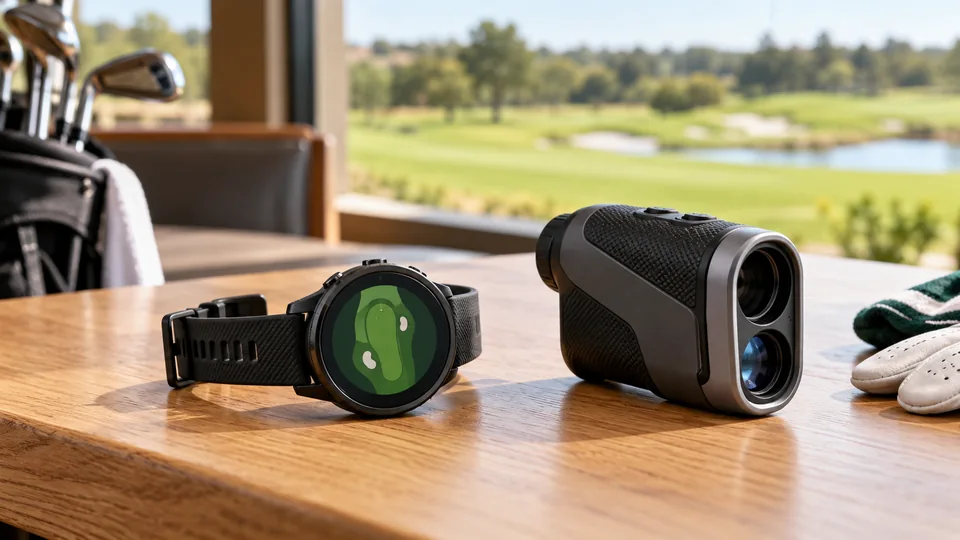
A golf GPS watch gives quick distances to mapped course features, while a laser rangefinder measures the visible target you aim at. Neither is automatically the better choice for every round. If you prefer a glance at your wrist, our golf GPS watch comparison is a useful starting point. The decision becomes clearer when you compare how each tool fits the shots and routines you actually encounter.
Think about an unfamiliar approach over a rise. A watch may still show mapped green distances when you cannot see the flag. Later, with the flag clearly visible and tucked behind a bunker, a laser can provide a distance to that particular target. Those are related jobs, but they are not identical.
What a GPS Watch Is Telling You
A golf watch uses positioning and course-map information to calculate distances relative to mapped features. Front, middle, and back green distances are common functions, while hazard details, maps, and other features depend on the model and software. Check what is included rather than assuming every golf watch displays a complete hole layout.
The middle of the green is not the day’s flag position. Some systems let you move a pin marker or use additional location information, but that capability needs to be verified for the actual device. A neat flag symbol on a screen should not be mistaken for a fresh measurement of the physical flagstick.
Course data can also change. A rebuilt green or altered hazard may not match an older map perfectly. When a displayed feature does not fit the scene in front of you, confirm the hole and course selection, check the map information, and use another reference rather than trusting the screen blindly.
What a Laser Rangefinder Measures
A laser rangefinder determines distance to a target in its line of sight. Aim at a flag, a bunker edge you can identify, or another suitable reference, then check that the result makes sense. It does not automatically understand the safest landing area or what lies beyond a hidden ridge.
That specificity can be useful on a clear approach. You can distinguish the flag from the back edge rather than treating a center-green distance as a substitute. It also creates a responsibility: a number from the trees behind the flag is still a number, and the display may look perfectly convincing.
Our golf rangefinder guide helps compare device types and features. If your main concern is laser use, pay particular attention to the viewfinder, target-acquisition method, and handling. A list of maximum-range specifications says little about whether you enjoy using the device during an ordinary round.
Compare the Everyday Workflow
| Situation | GPS Watch | Laser Rangefinder |
|---|---|---|
| Quick general green distance | Often available with a wrist glance | Requires a visible reference and measurement |
| Flag clearly visible | Usually relies on map or pin information | Can measure the target you aim at |
| Target hidden from view | Mapped features may remain available | Cannot directly measure an unseen flag |
| Handling preference | Must be comfortable on the wrist | Requires viewing, aiming, and storing |
A watch can suit someone who wants broad information with little interruption. That advantage disappears if the text is too small to read comfortably or the menu requires more tapping than expected. Try to judge the screen in conditions similar to those in which you play.
A laser adds a deliberate measuring step. Some golfers appreciate that short pause; others find it awkward to retrieve a device repeatedly. Consider where it will live on your bag or cart and whether you can put it away reliably after the shot.
Useful Accuracy Is About the Question You Ask
A laser reading to the flag and a watch reading to the green’s middle can both be reasonable while differing noticeably. They refer to different destinations. Before deciding that one device is wrong, identify precisely what each displayed distance represents.
The relevant decision may also be broader than the pin. If your normal miss is long, a back-edge distance can be useful. If a bunker must be carried, you need a suitable carry reference. Choose the information that helps manage the shot rather than assuming the most specific flag number is always the most useful number.
Do not expect either tool to remove uncertainty from your own club distances. A precise target does not make your longest seven-iron strike the correct planning figure. Combine device information with a realistic sense of ordinary carry and dispersion.
Subscriptions, Updates, and Total Ownership
Subscription requirements are model- and feature-specific. A watch may include basic golf functions while charging separately for advanced mapping or other services. Another device may package features differently. Check the current official feature list and plan terms before describing a watch as free or subscription-dependent.
If avoiding recurring fees is a priority, our GPS watches without a required subscription guide explains the distinction between base features and optional services. Also check whether updates or setup need a phone app or computer. No annual fee does not necessarily mean no setup work.
For a laser, examine battery arrangements, charging, warranty support, and any optional connected functions rather than assuming ownership costs stop at the checkout. Keep the comparison focused on features you will actually use. Paying for a detailed analytics package is hard to justify if you only want a quick green distance.
Wrist Comfort, Viewing, and Battery Habits
A watch should feel comfortable during address and the swing. Case size, strap adjustment, screen visibility, and how easily sleeves move over it can matter. A device that feels fine while sitting at home may become distracting after a long walk in warm weather.
A laser needs a viewfinder that works for your eyes and an aiming routine you can repeat. Glasses, eye relief, and hand movement affect that experience. Look at the actual display and controls if possible instead of inferring comfort from the device’s size or advertised magnification.
For both tools, build charging or battery checks into the pre-round routine. Manufacturer battery estimates depend on usage and settings, so leave margin rather than planning around the last advertised hour. A familiar backup reference is useful when any electronic tool is unavailable.
Choose One, Combine Them, or Keep It Simple
Choose a watch if quick mapped information and low-interruption use match your habits. Choose a laser if visible-target measurement is the job you most often need and you are comfortable aiming it. Carrying both can provide complementary references, but it is not a requirement for sensible course management.
Check competition conditions before using either device, particularly additional assistance features. Then select the setup you can operate without slowing your routine or distracting from the shot. The useful tool is the one that answers your next golf question clearly, rather than the one with the longest menu.
