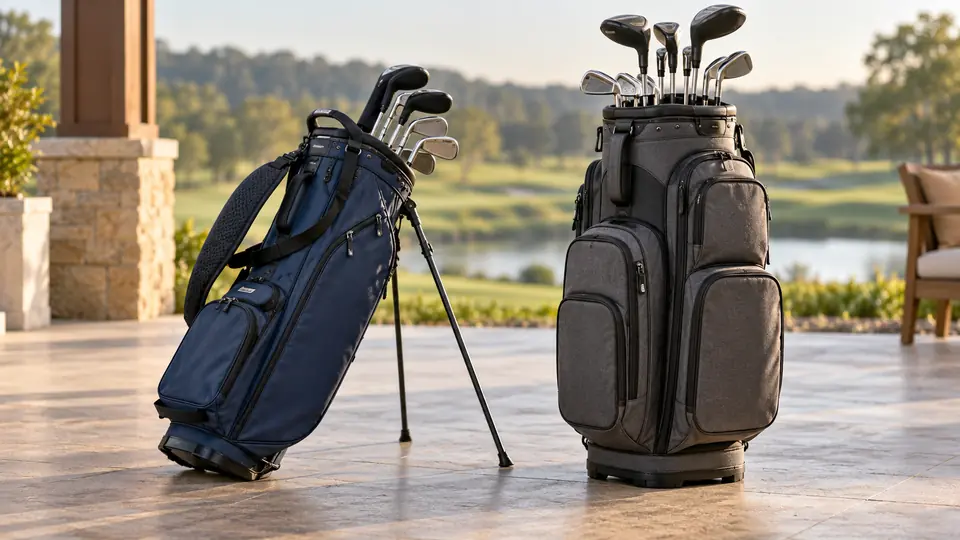
A stand bag suits a golfer who expects to carry clubs and set them down between shots; a cart bag emphasizes storage and access while attached to a cart. That is the basic distinction, but your usual way around the course matters more than the label. Start with our golf bags for walking if carrying comfort leads your decision, then check how the bag behaves during the rest of your routine.
The wrong choice often reveals itself in small annoyances: a strap blocking the pocket you use most, a bag turning sideways on a push cart, or clubs that are awkward to remove. Think through those moments before choosing the model with the biggest top or the longest feature list.
Start With How You Usually Move
Separate carrying, walking with a push cart, and riding in a motorized cart. All three can involve a full round on your feet, but they ask different things of the bag. A comfortable shoulder system is central to carrying and much less useful when the bag stays strapped onto a cart.
A stand bag has deployable legs so the bag can rest upright on suitable ground without leaning against something. Carry-oriented designs usually balance storage against manageable weight. A cart bag generally places more emphasis on structured storage and accessible pockets in a mounted position, though individual models vary substantially.
Hybrid bags try to bridge those routines. They can be useful if you carry some days and ride on others, but a hybrid label does not settle the trade-offs. You still need to inspect the actual straps, stand mechanism, base, weight, and pocket arrangement.
Compare Loaded Weight, Not Empty Weight Alone
An empty bag specification is useful, but you do not play with an empty bag. Add your actual clubs, balls, water, extra layer, and regular accessories before judging carrying comfort. Large pockets can make it tempting to bring things that rarely leave the bag.
Try the loaded bag with its straps adjusted properly. Notice whether it hangs comfortably, whether the clubheads crowd your shoulder, and whether picking it up feels straightforward. A bag that seems light when lifted by a shop handle can feel quite different once its load is carried along a path.
For a push-cart or riding-cart routine, extra bag weight may be an acceptable exchange for organization. It still affects lifting into the car, moving the bag through the garage, and getting it onto the cart. Choose storage for the items you actually use rather than treating unused capacity as a free benefit.
Dividers: More Slots Do Not Automatically Mean Less Tangling
A fourteen-way top gives each club a designated opening. A top with fewer sections groups clubs together and can offer a simpler arrangement. The visible openings are only part of the story: the internal divider construction determines how separated the shafts and grips remain farther down.
Check whether dividers run full length and how the manufacturer describes that construction. A fourteen-way label alone does not establish fourteen individually enclosed full-length channels. Grip diameter, club arrangement, and how the loaded bag rests can also influence how easily clubs come out.
If individual organization matters and you still need stand legs, our guide to stand bags with fourteen dividers is a useful next step. Test the arrangement with the clubs and grips you intend to use. An oversized putter grip is a particularly helpful compatibility check.
Put the Bag on the Cart Before Assuming It Fits
A stand bag can work on a push cart, but its legs, foot mechanism, and base need to cooperate with the cart’s supports. Look for unwanted pressure on moving parts, a bag that rocks in its cradle, or a lower strap that slips into an awkward position.
Also check the cart’s upper support. Straps should secure the bag without crushing the top or covering a pocket you need during play. Walk a short distance with a properly loaded setup, turn it normally, and look for rotation. The words “cart compatible” do not explain every possible bag-and-cart pairing.
Our golf bags for push carts comparison helps narrow that search. It is still worth checking the specific cart you own. A bag designed around a riding-cart arrangement may not provide the same balance or pocket access on a sloped push-cart frame.
Inspect Pocket Access in the Playing Position
A pocket that opens easily while the bag stands on a shop floor may face away from you once mounted. Imagine reaching for a ball, removing a rain jacket, or returning a rangefinder during a round. Those ordinary movements reveal whether the layout suits your routine.
Cart-strap pass-throughs can help keep a strap from blocking a compartment, but inspect their actual route. A useful pass-through on one cart may sit differently on another. Similarly, an insulated pocket is only helpful if you can access it and its contents without loosening the entire bag.
Think about wet items as well. Where will a damp towel hang, and where will a used glove or rain layer go? You do not need a separate pocket for everything, but you should avoid discovering that your only convenient storage space is shared by a wet jacket and valuables.
A Side-by-Side Decision Check
| Question | Stand Bag Emphasis | Cart Bag Emphasis |
|---|---|---|
| Will you carry regularly? | Strap comfort, balance, loaded weight | Check whether carrying is genuinely practical |
| Will the bag stay mounted? | Leg and base compatibility | Support fit and reachable storage |
| Do you change transport methods? | Convenience across several routines | Whether capacity justifies the compromises |
| Do you need club organization? | Divider construction and putter access | Divider construction and putter access |
The repeated divider question is deliberate. Organization is not exclusive to either category, and a large top does not automatically solve club access. Compare the actual construction rather than assigning every desirable feature to one bag style.
Do a Complete-Round Rehearsal
Before committing, run through the whole routine: load the bag, carry or roll it, remove a few clubs, reach the main pockets, and lift it into your vehicle. Include the space where it will be stored at home. A compact trunk or narrow storage corner may matter more than another accessory loop.
Check the stand on an appropriate surface and confirm that it deploys and retracts as intended. Follow any care and loading instructions, and do not force a mechanism that catches. If a cart pairing needs a manufacturer-supported adapter, include that requirement in your decision rather than planning an improvised fix.
Choose the bag that makes your usual round easier, while accepting the occasional compromise you can live with. Carrying twice a week and riding twice a year points toward a different balance than the reverse. The best fit becomes obvious when you judge the full routine instead of a bag standing empty beside a display.
