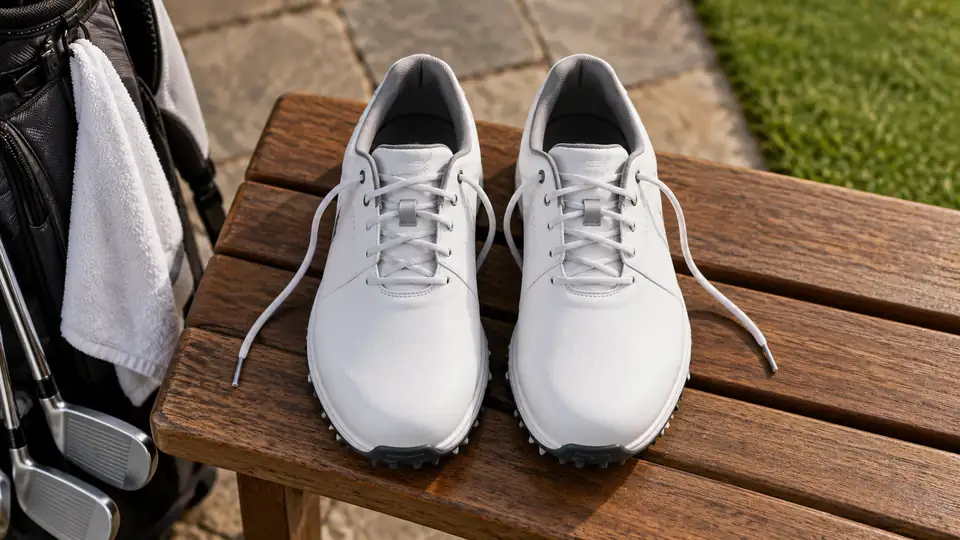
By the twelfth hole, a shoe that looked fine in the hallway can start negotiating with your little toe. The annoying part is that adding half a size often creates a new problem at the heel. Shopping for the best golf shoes for wide feet should begin with the width and shape of the actual shoe, before cushioning slogans or a sharp-looking color get a vote.
This comparison uses nine separate golf-shoe models in identified Wide, 2E, Extra Wide, or 4E configurations. Some are leather and cleated; others use an athletic upper or a spikeless sole. The width label describes a version worth trying, rather than a promise that every broad foot will find it comfortable. A high instep, low-volume heel, and broad toe spread can ask for different shapes.
These are research-based fitting comparisons, without invented walking-test results. Keep the exact selected model, generation, width, and size in view as you shop. Before the shoes reach wet grass, try both indoors with your golf socks and usual insert, walk normally, and make a controlled turn. The useful target is relaxed toes with a held heel, rather than a shoe that feels oversized everywhere.
Quick Answer
- Best Overall: Callaway Solana TRX v3, Wide.
- Dial-Closure Alternative: adidas S2G BOA Wide Spikeless, GV9789.
- 4E Extra-Wide Option: New Balance Fresh Foam Contend, 4E Extra Wide.
Comparison Table
| Product | Best Fit | Useful Feature | Main Trade-Off |
|---|---|---|---|
| Callaway Solana TRX v3, Wide | Best Overall | Selected wide configuration addresses a specific width need. | Replaceable cleats require inspection and periodic upkeep. |
| adidas S2G BOA Wide Spikeless, GV9789 | Best for Dial Adjustment | GV9789 identifies a wide-fit S2G model. | BOA tension does not change the underlying last shape. |
| FootJoy Traditions, Extra Wide | Best Traditional Cleated Option | Selected Extra Wide configuration goes beyond a conventional Wide option. | Leather construction can feel more substantial than light textile footwear. |
| Skechers GO GOLF Elite 5-GF, Wide | Best for an Arch Fit Insole | Selected wide build provides a clear fit variation. | Arch Fit contour will not suit every foot or orthotic. |
| New Balance Heritage, 2E Wide | Best Classic Sneaker Shape | Selected MG100GR build is identified as 2E Wide. | Cleats make it less of an all-purpose casual sneaker. |
| adidas TOUR360 24, Wide | Best Structured Stability Option | Selected configuration is explicitly Wide. | More structured construction may feel excessive to a minimalist-shoe buyer. |
| FootJoy Sneaker, Wide | Best for a Fuller Forefoot Shape | Selected wide configuration directly addresses width. | Fuller instep volume may feel loose on a broad but low-volume foot. |
| New Balance Fresh Foam Contend, 4E Extra Wide | Best Extra-Wide Athletic Alternative | Selected model code explicitly specifies 4E Extra Wide. | A 4E build may have too much volume for a golfer who only needs standard Wide. |
| FootJoy Pro/SL 53811, Wide | Best Previous-Generation Spikeless Option | Selected older-model configuration is identified as Wide. | Previous-generation offers need careful condition and warranty checks. |
1. Callaway Solana TRX v3, Wide: Best Overall
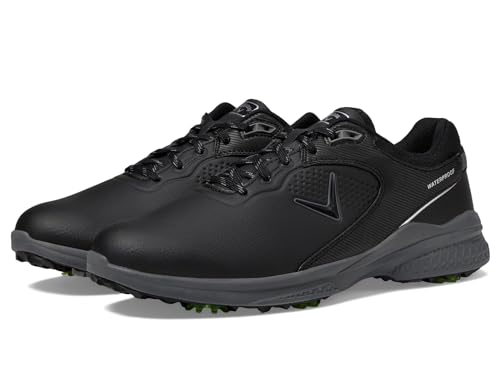
A wide shoe should solve a fit problem before it starts selling you a technology story. Callaway Solana TRX v3 gives this comparison a clear starting point with a selected wide build, a waterproof microfiber upper, and a cleated golf outsole. That combination is useful for the golfer whose little toe presses against a regular athletic shoe during the walk. More length is rarely a satisfying substitute for the right width, particularly when the heel then starts lifting on a slope.
The Solana uses a five-cleat layout and a Forged DX PLUS foam midsole, keeping cushioning and replaceable traction in the same package. Imagine a morning round that begins in wet rough and finishes on firm cart paths. The upper and cleats answer the weather and footing questions, while your actual forefoot and heel still decide fit. Lace the selected wide shoe with normal golf socks, walk a little, and check whether the toes have room without the midfoot sliding during a controlled turn.
Pros
- Selected wide configuration addresses a specific width need.
- Waterproof microfiber upper suits damp-round shopping.
- Five-cleat layout supplies golf-focused traction.
- Forged DX PLUS foam provides an identified cushioning layer.
- Lace closure allows separate forefoot and instep adjustment.
Cons
- Replaceable cleats require inspection and periodic upkeep.
- Microfiber cleated construction is less casual than a flexible mesh spikeless shoe.
Solana is the balanced place to start if you want a conventional wide golf shoe for mixed course conditions. Let the toe box, instep, and heel agree with your foot before judging the color or logo. The right width should feel useful during walking and turning, rather than simply looking generous in a product photograph.
To buy this product, click here.
2. adidas S2G BOA Wide Spikeless, GV9789: Best for Dial Adjustment
The little BOA dial changes the daily routine more than another decorative stripe. The GV9789 S2G BOA Wide is a specifically identified wide spikeless model, so its place here rests on the model configuration rather than a guess from the shoe’s outline. A golfer who repeatedly loosens laces across a broad instep may appreciate the chance to adjust closure tension quickly before the next tee. The dial cannot enlarge an unsuitable last, though, which is the first distinction to keep straight.
This earlier S2G BOA generation uses a textile-and-synthetic upper and Bounce cushioning, with a spikeless outsole. Do not transfer Lightstrike details from the later S2G 24 into this pair. Think about a round where you walk from the car park straight to the practice green: fixed tread can make that mixed-surface routine convenient. Check forefoot space with the closure relaxed, then tighten until the heel feels held. If getting heel security requires crushing the top of the foot, the fit is still wrong despite the wide label.
Pros
- GV9789 identifies a wide-fit S2G model.
- BOA closure offers quick tension adjustment.
- Bounce midsole provides cushioning.
- Spikeless outsole suits mixed-surface walking.
- Textile-and-synthetic construction offers an athletic alternative to leather.
Cons
- BOA tension does not change the underlying last shape.
- Fixed outsole tread cannot be renewed by replacing individual cleats.
Choose this S2G for its combination of a verified wide model and dial closure, with the earlier generation’s actual construction kept in view. An easy adjustment before a downhill walk is useful only after the base shape fits. Compare both feet in golf socks and keep enough return flexibility to assess the fit properly.
To buy this product, click here.
3. FootJoy Traditions, Extra Wide: Best Traditional Cleated Option
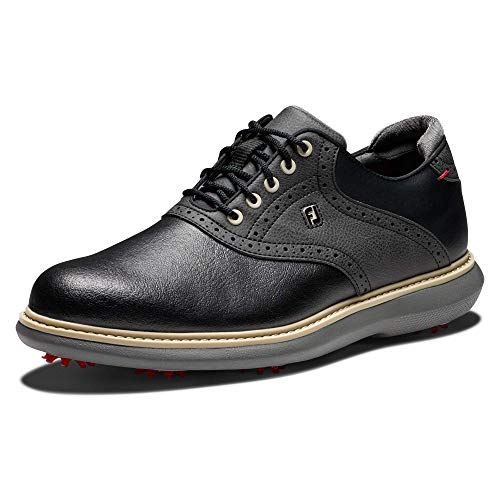
Traditions takes the polished leather route, with the selected 57904 extra-wide build providing a different fitting direction from an ordinary wide sneaker. That distinction matters for a golfer who already knows conventional Wide remains snug. Imagine reaching the turn with the outer forefoot pressing against the upper. Extra Wide is a worthwhile configuration to try; buying a longer regular shoe instead can leave the ball of the foot in the wrong place and the heel moving more than you want.
FootJoy combines the traditional upper with a cushioned Fit-Bed and replaceable cleats. The shoe’s waterproof positioning makes it relevant for early tee times, subject to the applicable seller and warranty terms. A second comparison belongs on a dry path: does the leather shape bend comfortably where your foot bends, and does the heel stay seated? Extra width should create usable space around the foot without making the complete shoe feel vague when you turn into a practice swing.
Pros
- Selected Extra Wide configuration goes beyond a conventional Wide option.
- Leather upper offers a traditional golf appearance.
- Cushioned Fit-Bed supports the comfort brief.
- Replaceable cleats provide a maintainable traction format.
- Waterproof model positioning is relevant to dewy rounds.
Cons
- Leather construction can feel more substantial than light textile footwear.
- Cleated soles add maintenance and are less convenient for extended off-course wear.
Traditions is worth trying if you want extra width without abandoning a traditional golf-shoe shape. It is a fitting alternative, rather than a promise that every broad foot needs the widest available label. Check the forefoot, arch contact, and heel together before the shoe earns a place beside the bag.
To buy this product, click here.
4. Skechers GO GOLF Elite 5-GF, Wide: Best for an Arch Fit Insole

An ample toe box can still feel wrong if the underfoot shape presses in the wrong place. The selected wide Elite 5-GF adds Skechers’ removable Arch Fit insole to the conversation, giving the golfer another contour to compare alongside width. This is the lace-up 214065 family, rather than the Slip-ins dial version. Keeping those models separate matters when a shoe is chosen for a particular closure or insert arrangement instead of merely the Elite name.
ULTRA FLIGHT cushioning sits beneath a lightweight textile-and-overlay upper. Imagine a golfer walking the final three holes who notices both forefoot squeeze and a tiring underfoot feel. The wider build and cushioning address different parts of that shopping problem; neither proves a medical outcome. Try the factory insole before assuming another insert will work. An orthotic changes internal volume and can lift the heel, so removing the stock insert and checking the complete fit is more useful than forcing two layers into the shoe.
Pros
- Selected wide build provides a clear fit variation.
- Removable Arch Fit insole permits a separate contour comparison.
- ULTRA FLIGHT cushioning supports an athletic walking feel.
- Lace closure lets you tune tension across the upper.
- Textile-and-overlay construction differs from a traditional leather shoe.
Cons
- Arch Fit contour will not suit every foot or orthotic.
- The lace-up model does not provide the separate Slip-ins version’s hands-free entry.
This Skechers is a sensible comparison for a broad foot whose comfort question includes insole shape. Stand, walk, and make a gentle turn before deciding whether that contour agrees with you. A wide label and a recognizable cushioning name are starting information, while the complete shoe still has to fit the person wearing it.
To buy this product, click here.
5. New Balance Heritage, 2E Wide: Best Classic Sneaker Shape

Heritage brings a familiar sneaker silhouette to a cleated golf shoe, and the selected MG100GR-10 2E configuration gives the width claim a concrete basis. That is useful for a golfer who likes a less formal address view but still wants a dedicated golf outsole. The 2E designation belongs to this specific men’s build. It should not be transferred to every Heritage offer, especially if the selector has changed to a regular width while you compare colors.
The DynaSoft midsole, CUSH+ insole, and waterproof microfiber upper give this model its own construction story. Replaceable cleats add another difference from a court-inspired spikeless shoe. Think about stepping across damp turf on the way to a raised tee, then standing over a putt on firmer ground. Compare how the forefoot spreads and how the heel stays held in both positions. A roomy sneaker look can be appealing, but the actual 2E last and your instep height still determine whether the shoe feels secure.
Pros
- Selected MG100GR build is identified as 2E Wide.
- DynaSoft midsole provides a defined cushioning feature.
- CUSH+ insole adds another underfoot layer.
- Waterproof microfiber upper suits damp-course comparisons.
- Replaceable cleats offer a maintainable golf traction system.
Cons
- Cleats make it less of an all-purpose casual sneaker.
- A 2E build can still be too narrow for a golfer who needs 4E or a different last.
Heritage is the crossover-looking option for a golfer who still wants a cleated golf platform. Confirm the 2E selection, then check the shoe through a normal walking stride and a controlled turn. The purchase makes sense when that complete shape fits, rather than because the side profile resembles a favorite everyday sneaker.
To buy this product, click here.
6. adidas TOUR360 24, Wide: Best Structured Stability Option

TOUR360 24 feels like the serious stability branch of this shortlist on paper: a 360 Wrap construction, a Torsion Bridge, and a specifically selected wide build. Those are reasons to compare it for a golfer who wants a secure connection around the midfoot while keeping space across the front. Picture a sidehill stance with the ball below your feet. A shoe that is merely loose everywhere is a different proposition from a wide shoe that still holds the heel and midfoot deliberately.
adidas combines Lightstrike and BOOST cushioning in this generation, with a golf-focused cleated outsole. The selected size 9.5 Wide is one configuration, rather than a claim that every TOUR360 offer is wide. On a long walk, compare the more structured platform with a softer sneaker-style option before committing. The extra support-oriented construction can be appealing during a turn, while a golfer who values a flexible, low-fuss feel may prefer a different direction. Both reactions belong in the fit check.
Pros
- Selected configuration is explicitly Wide.
- 360 Wrap construction supports a connected midfoot fit.
- Torsion Bridge provides a defined stability feature.
- Lightstrike and BOOST supply cushioning elements.
- Cleated golf outsole suits a structured on-course setup.
Cons
- More structured construction may feel excessive to a minimalist-shoe buyer.
- The selected 9.5 Wide size will not match every shopper’s required length.
TOUR360 is the model to compare when a broad forefoot must coexist with a more structured golf platform. Try a walking stride as carefully as a practice stance. A supportive-looking shoe should still bend and hold in places that agree with your foot, without pressure building across the instep as the laces tighten.
To buy this product, click here.
7. FootJoy Sneaker, Wide: Best for a Fuller Forefoot Shape

FootJoy’s Sneaker has a particularly useful last description for this topic. The Competition last combines a rounded toe, fuller forefoot, full instep, and a slightly narrower heel. The selected wide build therefore gives a golfer more to compare than an unexplained claim of a roomy shoe. Imagine having a broad front of the foot but a heel that slips in shoes chosen simply by going up a size. That front-to-back shape becomes a meaningful part of the shopping conversation.
The full-grain leather upper has waterproof positioning, with a cushioned FitBed and EVA construction underneath. A rubber golf outsole keeps the model in an everyday golf-shoe role. During a dry indoor fitting, check whether the fuller instep actually matches your foot volume. In another scenario, a golfer using a thicker cold-weather sock may need a different amount of internal room from the same foot in a thin summer sock. Fit the shoe for the socks and insert you will really wear.
Pros
- Selected wide configuration directly addresses width.
- Competition last describes a fuller forefoot and instep.
- Slightly narrower heel offers a distinct shape to compare.
- Full-grain leather upper has waterproof positioning.
- Cushioned FitBed and EVA support the walking-comfort brief.
Cons
- Fuller instep volume may feel loose on a broad but low-volume foot.
- Leather construction can feel less airy than lightweight mesh.
The Sneaker is a good fitting comparison for someone who needs forefoot room while still caring about heel hold. Its value here is that defined shape, rather than a universal comfort promise. Check both feet and the instep pressure before deciding whether the selected Wide version is the correct balance.
To buy this product, click here.
8. New Balance Fresh Foam Contend, 4E Extra Wide: Best Extra-Wide Athletic Alternative

For some golfers, 2E still feels like a compromise. The selected NBG4006GRC-9 4E Fresh Foam Contend offers an explicitly extra-wide configuration in an athletic spikeless model. That gives a genuinely broad foot another direction to try without stretching a regular-width upper through wishful thinking. This is the earlier Contend generation, not Contend v2 or v3, so the model’s own details matter more than whatever technology appears on the newest product page.
Fresh Foam cushioning, a CUSH+ insole, and a pressure-mapped rubber outsole form the practical feature set. The microfiber-and-mesh upper is sold with waterproof positioning, with applicable warranty terms to check for the actual offer. Picture a long summer walk where the toes need room as the round progresses. Then consider a wet morning where heel security and upper protection matter too. Extra width should solve front-of-foot pressure while the lace adjustment and heel shape still keep the shoe controlled during a turn.
Pros
- Selected model code explicitly specifies 4E Extra Wide.
- Fresh Foam midsole supplies an athletic cushioning option.
- CUSH+ insole provides an additional underfoot layer.
- Rubber spikeless outsole suits mixed-surface use.
- Waterproof model positioning is relevant to damp conditions.
Cons
- A 4E build may have too much volume for a golfer who only needs standard Wide.
- Fixed tread cannot be refreshed with individual replacement cleats.
Use the Contend as an extra-wide fitting option rather than assuming the largest width is automatically the most comfortable. Check the selected 4E code, the actual size, and the condition of the offer. A secure heel with relaxed toes is a more useful goal than buying a shoe that simply feels big all over.
To buy this product, click here.
9. FootJoy Pro/SL 53811, Wide: Best Previous-Generation Spikeless Option

This Pro/SL is the earlier 53811 model in a selected wide configuration, with Fine Tuned Foam cushioning and a spikeless golf platform. It gives the broad-footed golfer a different FootJoy format from Traditions or the Sneaker. The distinction is practical: a golfer who wants leather-shoe support without separate cleats has another option to compare. Do not borrow ARCTrax, Z-TEC, or other features from a newer Pro/SL generation just because the family name matches.
The dual-density midsole and leather upper belong to the older model’s documented construction. Picture walking from the car park to the first tee, then turning on firm turf during a rehearsal swing. The fixed outsole can suit that routine, provided the tread and fit match the conditions. Since this is a previous-generation offer, inspect the actual seller description, size conversion, condition, return terms, and warranty coverage. A UK-size label should be converted carefully before you compare it with the US size in another shoe.
Pros
- Selected older-model configuration is identified as Wide.
- Fine Tuned Foam provides a documented cushioning feature.
- Dual-density midsole combines comfort and platform support.
- Spikeless outsole avoids separate-cleat replacement.
- Leather golf-shoe format offers a distinct feel from mesh athletic models.
Cons
- Previous-generation offers need careful condition and warranty checks.
- Fixed outsole wear cannot be addressed by replacing individual spikes.
The older Pro/SL can be considered for a wide-footed golfer who prefers a spikeless leather platform. Choose it on the actual model and offer, with the size conversion checked twice. If the seller’s condition or return terms are unclear, a different verified configuration is a better purchase than relying on the reputation of the family name.
To buy this product, click here.
Buying Guide
Separate Width from Length
Measure both feet and compare the longer and broader foot with the maker’s chart. Adding length to escape forefoot pressure can move the flex point and leave the heel loose. A Wide, 2E, or 4E label gives you a better-defined trial, but those labels do not create identical interior shapes across brands. Check toe spread, the ball of the foot, and the lace area together. A fit that works while standing still should also feel controlled through a normal walking step.
Check Instep Volume and Heel Hold
A golfer can have a broad forefoot and a relatively slim heel, or a high instep that needs more upper volume. Those are different fitting problems. Tightening a BOA dial or lace harder can secure one area while creating pressure somewhere else. Look at the tongue and closure gap, then take a few indoor steps. The heel should stay seated without the front of the shoe being squeezed. A last description such as fuller forefoot and narrower heel is useful information to compare with your own shape.
Fit with the Insert and Socks You Use
An orthotic or thicker sock changes the room available inside a shoe. Try the intended combination rather than buying from width alone and hoping the insert will fit later. A removable stock insole makes a replacement trial easier, but it does not guarantee enough depth or a compatible arch contour. Stand on the complete setup, walk, and check the heel height. If the insert lifts the heel against the collar or crowds the toes, the shoe still needs a different fitting choice.
Choose Traction for the Course
Replaceable cleats give a golf-focused traction format with an upkeep task, while fixed spikeless tread can suit a course-to-clubhouse routine. Neither format guarantees footing on every surface. Consider soft grass, sidehill lies, wet paths, and how much walking happens away from turf. Inspect cleats and tread periodically. A wide shoe that fits beautifully still needs an outsole suited to the conditions, and worn traction should not be excused merely because the upper remains comfortable.
Keep Waterproofing Separate from Breathability
A textile upper can include waterproof construction, and a leather appearance alone does not establish the applicable protection. Read the selected model’s specification and warranty terms, including normal-use and care conditions. A dew-heavy morning and a hot dry afternoon can make you value different features. Compare upper protection, ventilation, drying routine, and the socks you use as separate parts of the decision. Waterproof positioning should not be stretched into a promise about every rainstorm or every seller’s warranty.
Check the Exact Generation and Return Terms
The same family name can cover different uppers, cushioning, tread, and width selections across generations. Keep the model code and selected width visible while changing sizes or colors. Previous-generation offers also need a clear condition description and a usable return policy. Inspect new shoes indoors first, within the retailer’s conditions, before taking them onto the course. A well-documented current fit is more useful than a steep discount attached to a neighboring size that does not match your foot.
FAQ
Is 2E the same as Extra Wide?
Width terminology varies by brand and category. In many men’s shoes, 2E is Wide and 4E is Extra Wide, but the selected maker’s chart should decide. FootJoy and other brands can use their own named widths. Compare the actual model code rather than converting labels by assumption.
Should I size up instead of buying Wide?
Extra length can create heel movement and move the shoe’s bend away from the ball of the foot. Try the proper width in a suitable length first. If the instep or toe shape still feels wrong, another last may work better than a larger size of the same narrow shape.
Does BOA make a shoe wider?
No. BOA changes closure tension over the existing upper and last. It can make adjustment convenient, but it cannot create a different underlying toe-box shape. Start with the appropriate wide model, then use the dial to secure the fit without pressure across the foot.
Can I use my orthotic in these shoes?
Check the particular shoe, removable insole arrangement, and internal depth with your actual orthotic. Replacing the stock insole may help, while stacking inserts can crowd the shoe or raise the heel. An appropriate fit should still hold the heel and leave useful forefoot space.
Are all versions linked under one product page wide?
No. A selector can move between regular and wide configurations, and colors can have different sizes available. Recheck size, width, generation, and the order summary after changing any option. The model family offering Wide does not prove the currently selected box is Wide.
Are previous-generation shoes a sensible purchase?
They can be a fitting option if the exact model, width, condition, seller, return terms, and warranty coverage are clear. Do not transfer the newest model’s technical details into an older offer. A low price cannot compensate for a wrong size or uncertain condition.
Final Verdict
Solana TRX v3 Wide is the balanced starting comparison for a cleated, weather-focused golf shoe. S2G BOA Wide offers a dial-adjustment route, while Fresh Foam Contend 4E is the extra-wide athletic alternative. Each earns its role through a different combination of fit configuration and construction, with personal comfort left to a proper fitting check.
Choose the exact width and size that let the toes relax while the heel stays seated. Then compare cushioning, upper protection, and traction for the course you play. If a promising shoe needs to be overtightened or oversized to feel tolerable, keep looking at another shape. A comfortable eighteenth-hole walk starts with the fit you confirm before the first tee.
