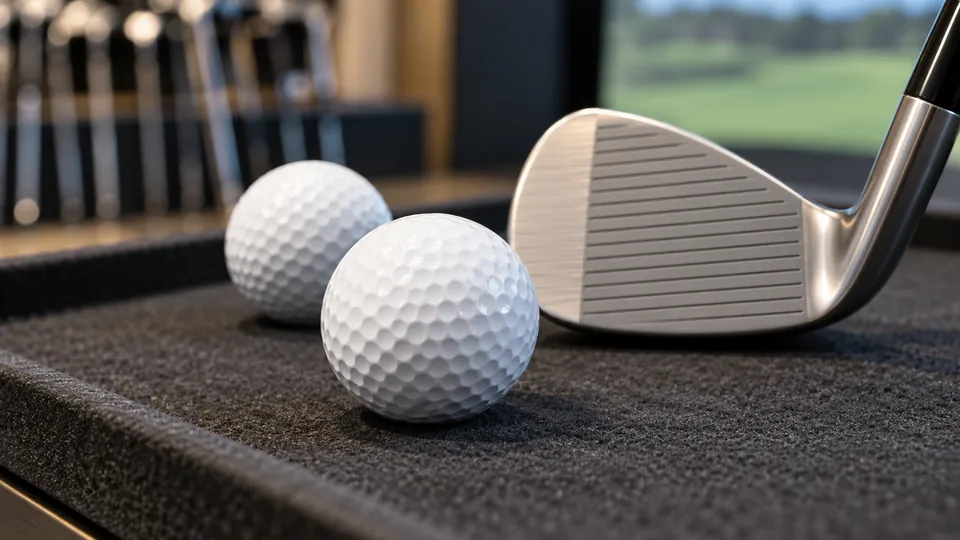
Urethane and ionomer are golf-ball cover materials, and the most noticeable trade-off often appears on shots around the green. Urethane-covered designs commonly emphasize short-game control, while many ionomer-covered balls prioritize affordability and durability. If a predictable check on a pitch is your main concern, our golf balls for greenside spin guide provides a shortlist. The cover label still needs to be considered alongside the whole ball and the shots you play.
A little chip landing on a firm green can reveal a difference that a driver swing barely helps you interpret. Yet choosing the more expensive cover does not automatically produce a lower score. Contact, surface conditions, preferred trajectory, and replacement cost all deserve a place in the decision.
The Cover Is One Part of the Ball
The cover is the outer material surrounding the ball’s internal construction. Urethane and ionomer describe different material families, not a complete recipe for speed, feel, or flight. Core design, intermediate layers, cover formulation, thickness, and aerodynamics also contribute to the finished product.
That is why two urethane balls can behave differently and why two ionomer balls should not be assumed identical. Layer count is another separate characteristic. Do not read “three-piece” as proof of a urethane cover, or assume that more layers always produce a better result for your game.
Feel can complicate the comparison further. A soft-feeling ball is not necessarily urethane, and a firm-feeling ball is not necessarily lacking short-game performance. The sound and sensation at impact reflect more than the material touching the clubface.
Where Urethane Can Make the Difference
On many urethane-covered designs, the cover helps deliver the friction and interaction sought for controlled wedge shots. That can be useful when you want a pitch to stop sooner after landing or need more options than a running chip. It is a reason to compare the ball on short shots, rather than judging it only from the tee.
Do not turn that general design tendency into a promise that every pitch will grab. A clean strike from a suitable lie differs from a shot with grass or moisture between the face and ball. Wedge condition, loft, delivery, landing angle, and green firmness can all change what happens next.
Picture a low pitch to a shallow landing area. Extra stopping ability may be useful there, provided you can produce the intended contact. On a long chip with plenty of green to work with, predictable release might matter more than maximizing check. The shot you need should lead the comparison.
Where Ionomer Can Be a Sensible Choice
Ionomer covers are widely used in value-oriented golf balls and can offer practical durability for ordinary play. For someone who loses balls frequently or prefers a straightforward running short game, those priorities can make sense. Buying a cover you are comfortable replacing is part of making a usable choice.
Do not assume a lower price means a ball cannot produce useful distance or an enjoyable putting feel. Those qualities depend on the actual model and your delivery. Equally, an inexpensive ball that repeatedly releases farther than you expect may require more adjustment around the green than you want to make.
Our budget golf ball comparison helps identify options without treating every affordable ball as interchangeable. Compare cover details, pack size, and the intended playing characteristics instead of selecting solely by the largest discount badge.
| What to compare | Urethane cover | Ionomer cover |
|---|---|---|
| Feel on short shots | Often associated with a softer feel. The finished ball still matters. | Feel varies by formulation and the rest of the ball. |
| Greenside spin | Often used in balls intended to provide more short-game spin. | Many models emphasize durability and value, though spin differs by ball. |
| Driver performance | Cover material alone does not predict distance or flight. | Compare the complete ball rather than assuming a distance advantage. |
| Durability | Check the actual ball for scuffs after play. | Often chosen for durability, but individual models still vary. |
| Cost and choice | Often found in higher-priced balls. Compare the price per ball. | Often available at lower prices. Check the whole ball against your needs. |
Driver Distance Does Not Follow a Simple Cover Rule
Neither material guarantees that a ball will be your longest option. Driver performance comes from the complete construction interacting with impact and flight conditions. A statement such as “ionomer is for distance and urethane is for spin” leaves out too much to be a reliable fitting method.
Also distinguish driver spin from greenside spin. A manufacturer can pursue different behavior at different impact conditions through the overall design. A ball offering short-game control is not automatically a high-spin driver ball, and a soft putting sensation does not settle either question.
If you compare tee shots, use several representative strikes and observe usable flight and dispersion as well as distance. A single ball that bounces down a dry slope tells you little about the cover. Look for patterns you can reproduce, ideally without changing the club or conditions between candidates.
Durability: Inspect the Ball You Actually Have
Durability depends on the particular cover formulation, the surfaces it strikes, and how it is used. Cart paths, trees, and sharp contact can damage either type. Avoid assuming an entire cover category is indestructible or that every urethane ball becomes unusable after a few wedge shots.
Look for cuts, significant scuffs, or a visibly damaged surface during ordinary ball checks. A cosmetic mark is different from an obvious cut, but guessing at the performance of a badly damaged ball is not a useful way to save money. Follow the applicable rules when replacing a ball during a round.
For a fair durability comparison, note what caused the wear. A scrape after a pavement bounce should not be recorded as the result of normal wedge play. Keeping those observations separate makes your notes more useful than a simple “lasted one round” verdict.
Compare Cost Per Ball Before Comparing Value
A low headline price may cover a different quantity, an older generation, or a different condition grade. Check whether you are comparing new balls with new balls and equivalent pack sizes. A price threshold without those details can create a misleading impression of savings.
Our guide to golf balls under $30 discusses models and pack sizes for that reason. Work from the current configuration available to you. Do not assume that a dozen-ball price and a smaller trial pack describe the same buying decision.
Think about the trade-off in terms you can observe. Does the more expensive candidate make a needed pitch more predictable? Can you afford to practice and play with it consistently? Those questions are more useful than inventing an exact number of strokes or dollars a cover material will save.
A Short Test That Keeps the Choice Manageable
- Choose one realistic candidate from each cover category, with the model details confirmed.
- Compare putts to learn the sound and pace feedback you prefer.
- Play a running chip and a pitch that needs a controlled landing.
- Check approach and tee-shot behavior where the practice setting permits a fair comparison.
- Repeat the useful shots and decide whether the difference justifies the price for you.
Keep the early comparison simple enough that you can remember what you learned. If the balls are difficult to tell apart, identify them clearly rather than relying on memory after collecting a pile beside the green. Use the same type of shot and a similar lie whenever possible.
Choose urethane because its actual performance helps the shots you need, or choose ionomer because its balance of behavior and cost suits your rounds. Neither decision needs a prestige argument. A familiar ball with understandable trade-offs is easier to play confidently than a material label you expect to solve everything.
